Search This Blog

Sunday, 17 February 2013

THIS WEEK: Django Unchained / Wreck-It Ralph

0 - No Redeeming Feature

1 - Poor

2 - Passable

3 - Good.  Rent it.

4 - Excellent!

5 - Must See!!


DJANGO UNCHAINED  (2013 - UK Certificate 18)


Quentin Tarantino's best films are his debut Reservior Dogs, Pulp Fiction and Jackie Brown.  It's not that everything since is bad, but there was a notable change in the type of film he wanted to make from that point.  Having admired many technical aspects of Kill Bill, the deliciously sinister nature of his grind house homage Death Proof, and the fantastic set pieces of Inglorious Basterds, I can say that Django Unchained, his story of a slave-turned-bounty hunter fighting to rescue his wife from a plantation, is his most focused and solid delivery since that change.

By now anybody reading will know the basics of the synopsis, so I won't go into much detail.  Jamie Foxx is Django, in which the D is silent.  He explains this in a simple but splendid "wink wink" exchange with Franco Nero in a cameo spot, typical of the cinema encyclopedia that is Tarantino; Nero was Django at a time, and that knowledge makes their exchange a fun tidbit.  For those of my generation, he may be more easily identified as the bad guy being sprung free in Die Hard 2.  Foxx is perfectly fine as the central character, although there is an irony in the fact that, by the nature of the story, he is given little to do for a fair clump of the running time, so falls into the shadow of other cast members, somewhat.  Those other members are uniformly impressive:  Christoph Waltz is the bounty hunter Dr. King Schultz (cheekily clever name); he is dangerous, charming and witty, much like his character in Inglorious Basters; the difference here is that he is the good guy, setting Django free and proceeding to help him perform the daring rescue of his woman.

Leonardo Dicaprio is nothing short of perfect as the young, petulant Calvin Candie, proud owner of a plantation, sickeningly enthralled by man-din-go fighting to the death, and in the most surprising turn, we have Samuel L. Jackson as the twisted Uncle Tom character Stephen.  This latter performance is truly phenomenal, by turns humorous and sincerely scary.

Tarantino's handling of the sensitive backdrop for the story is impressive; with all the hooting and hollering about political insensitivity, the fact is he tackles the traits of the time, two years before the American Civil War, with a sure-handedness that I must say might surprise many.  The film does not shirk away from some nasty modes of thought and activities deemed acceptable at the time, but as far as what the director would call the "real violence" is concerned, he doesn't rub our face in it more than is necessary; rather, just enough that it balances with the stylized "cartoon violence" and makes it all the more cathartic.  In terms of style, all the typical trademarks we now expect of the man are here: the no-holds-barred approach to making it an in-your-face experience, great source music, real in-camera effects work that really drives home the violent elements, and fantastic dialogue that is a joy just to behold, particularly when Jackson and Waltz get to open their mouths, because as Tarantino says, they were born to say his words.

Just a few particularly good examples can be found in the extended bar sequence where Dr. Schultz explains to Django what it is he does, a brief but fantastic exchange between the two as Schultz takes aim at a  soon-to-be corpse, Stephen's reaction when he first meets Django, which only Jackson could make as funny as he does, and a very funny scene everybody is talking about, which ridicules the Klan.

Now, the film is not without problems.  For all the tension and drama successfully created elsewhere, the love connection between Django and Broomhilda is one I never really buy, and so that which is effectively the heart of the film runs close to flat-line.  The sense of connection, and the stakes at risk, are well generated between other characters, but there is no true sense that Django and Broomhilda ever truly lost anything.  This is not to say they didn't, but we don't get a convincing sense of it; this follows through with a lack of chemistry between them in the final scene of the film.

Speaking of that final scene, the tone Tarantino goes with, taking his foot off the pedal and going out on a note that plays more like an episode of Zorro, feels out of step.  In fact, whilst the juggling of different tones is something the director appears to have a generally good handle on, it is also a frustrating element of his film making.  As was most evident in Inglorious Basterds, his desire to embrace and mesh various genre conventions sometimes gets in the way of what could be a terrific genre piece; this is evidenced by the darker, more gripping, nasty scenes, moments that make me think, "I want to see what that movie is like".  Instead of that, we meander through a film that defies genre and on one hand deals very reverently with slavery through a love and revenge story, but on the other feels like it is little more than playing dress-up.  It bugs me, because he is such a great cinematic mind, I do not doubt that if he removed himself from his work a little, he could create something monumental.

The thing is he has always been in love with everything he writes, himself even having said that upon completion of his screenplay, he feels he has the finished product, can happily publish it as a book and not bother making the movie.  This is a problem; he clearly struggles to understand that whilst he may be happy he has written War and Peace, not everyone will feel the same; ironically, he is also known for his snappy dialogue and genuinely smart direction within individual set pieces.  The final consequence of all this is that the film is not only crammed full of sequences that are stunningly written, funny, tense, dark and lavishly staged, but also with bits and pieces that simply run too long, don't quite fit, or aren't needed, and so it becomes too bloated for its own good.  Not far off three hours when two would have done perfectly fine to tell his story, it is as though with a lack of, or perhaps in spite of a strong editor (R.I.P Sally Menke), he insists on a sometimes unfocused and self-indulgent piece.  Evidence of this issue could not be clearer than in the casting of himself in a superfluous role, in an absolutely unnecessary act of the film; if his lack of presence doesn't take you out of the movie somewhat, the dreadfully unconvincing Australian accent only illuminates the bad decision for you.
With all I've said, my rating may surprise you.  This is because, despite all the issues, I do accept Tarantino as the director he is, and Django Unchained tackles a serious topic with verve, building from it a story that does enthrall, and makes for some exciting, unpredictable, if sometimes frustrating cinema. The writing is typically Tarantino, uncensored and wild, at its worst a bit too much, but at its best snappy and exciting.  The performances are terrific, his unique use of anachronistic music proves he has long-since perfected the art of meshing visual and sound in a fashion that is far from typical.  His flair for the fun and theatrical is very much on show throughout, and his penchant for a good shootout certainly hasn't worn thin.  The main action sequence before the final act of the movie brings to mind the standoff in True Romance, only it is significantly more insane, but unlike the Crazy 88 scenes in Kill Bill Vol 1. he does not provide the refuge to a shift to black and white; blood squibs go off left, right and centre, painting everything crimson...everything!

This is indeed thrilling, although I must say that it is also notable at this stage how good a shot Django has become.  Indeed the film gets a case of what I could call "the Commandos" (if you don't get that, you need to brush up on your Schwarzenegger filmography), with one man who, before being freed would never have touched a gun, having become the greatest gunslinger alive with apparently little struggle, whilst we watch the bad guys stumble about in packs, sometimes with a clear shot of Django, and failing miserably.  Are these guys really this bad, or is Django impervious to bullets?  I understand it's a revenge convention, and I'm not looking for a great deal of realism at this point, but a sense that Django might have failed would have been welcome. 

Django Unchained is very much a film only Tarantino could make, which means, even with the things I think are wrong with it, you could never accuse it of being boring.  Whether your reaction to the more over the top, incendiary elements is positive or not, it is an engaging thrill ride, and his most impressive work since Jackie Brown.  A flawed, but bold movie.


4/5


At cinemas now.
Catch if it you like:  Quentin Tarantino

WRECK-IT RALPH  (2013 - UK Certificate PG)


Wreck-It Ralph takes us into the imaginary "behind the scenes" world of arcade video games, in which we see that characters controlled by the game players by day have their own lives by night.  Ralph is the bad guy in a retro, 8-bit arcade game who is tired of not being liked for doing his job, namely wrecking a building while the good guy, Fix-It Felix Jr, repairs the damage.  He makes the decision to "go turbo", abandoning his own game and venturing into a new, shiny one called Bug Hunt; his aim is to get himself a medal, earn a bit of respect and, perhaps, even adoration.  Through an amusing set of circumstances Ralph finds himself in the company of a young girl named Venellope, a character in the ridiculously bright racing game Sugar Rush, who is not allowed to race due to a glitch in her programming.  Together they aim to get Venellope into a race, and Ralph his medal; this sets in motion a story that is typically and, at points, generically Disney.

When described it sounds a little too close to the Pixar classic Toy Story, from which it does take its cue, and so it is easy to assume it will automatically fall flat.  So what makes it not?  There is clearly a "geek factor" to this film, with numerous cheeky and amusing cameos by characters everybody who ever played games will recognize, with the games themselves clearly being based on known titles.  There is also a smart observation of the look of different eras of gaming; notice how wonderfully rendered the more up to date games characters look when compared to those of the 8-bit Wreck-It Ralph, with their jumpy animation summoning an immediate sense of nostalgia.  The most notable reason for it working, however, is its presentation of a completely engaging, well-written story, and its creation of tremendous central characters.  The voice acting is the best I have heard for some time; among the talent are John C. Reilly and Sarah Silverman, the latter, I suspect, winning over even those who do not like her.  We find ourselves really caring about these game characters, honestly charmed and sincerely moved by their adventure.

The theme and moral is nothing new for movies of this ilk, but it is excellently put together, feels fresh, and the plot itself even has an intelligent, mature progression that will engage the children and speak to the parents.  I had a couple of issues with some of the heavy handed product placement, one character coming across as rather unoriginal due to an obvious comparison with a previous, classic Disney character (you can't not notice it, it seems intentional), and I felt using an existing song by Rihanna in the middle of the film, rather than a track written specifically for it, to be misjudged, but overall these are little, personal complaints, about which not everybody will feel the same.

Rich Moore arrived as the director with an impressive set of credentials in TV; being attached to, among other things, The Simpsons and Futurama is no bad starting point.  Whilst it can be said it does not quite reach the heights of the Pixar classics, Moore has created a film that is charming, creative, moving, and a joy from which all ages can get pleasure.  As I walked out of the auditorium with the perfectly suited, up-beat, closing credit song by Own City buzzing through my head, I was already thinking Wreck-It Ralph is absolutely going to be one of the best releases of 2013!  I stand by this.

Gamer or no gamer, young or adult, you should see this movie!

4.5/5


In cinemas now
Catch it if you like:  Video games, Cars, Monsters Inc., Toy Story.


Saturday, 9 February 2013

THIS WEEK: Flight / Untouchable

0 - No Redeeming Feature

1 - Poor

2 - Passable

3 - Good.  Rent it.

4 - Excellent!

5 - Must See!!


 FLIGHT  (2013 - UK Certificate 15)

Robert Zemickis returns to live action cinema with Flight, which surely presents what must be Daniel-Day Lewis' closest competition for the Best Actor award at this year's Oscars; there is no doubt that Denzel Washington is the reason, above all others, to see this movie.  He plays Captain Whip Whitaker, a pilot who crash lands a plane in a way that, it is later proved, nobody else would even consider, let alone be able to execute successfully (it really is genius!); he saves almost everybody on board, and becomes a hero.  How was he able to keep his head, while all around him were losing theirs, and perform this heroic and seemingly impossible feat?  Was it being the expert pilot he is, or was his ingenuity and gutsy handling of the situation a result of being hopped up on cocaine, and enough alcohol to make driving a car illegal?  Is his irresponsible action forgivable by virtue of the fact that, had he not been there, everybody would have died?  This is the conundrum the movie explores, and it even ponders the possibility of higher power, divine guidance, and bigger plans than we can imagine for those in need.  The latter theme may prove too lofty for some of the audience, and there are a couple of points where I must confess I felt it was a bit heavy-handed with the subject.  Then again, it is a trait that seems to appeal to Zemeckis and so should come as little surprise; consider previous work such as The Polar Express, Forrest Gump and Cast Away.  This, however, is not the only area that will feel familiar to Zemickis fans; the airplane disaster sequence is a few notches more frantic, bone-rattling and tense than the one we saw in Cast Away.  It is also possibly the best sequence of its kind that I have ever seen, and I saw Peter Weir's Fearless, which says a lot!
After this incredible opening it becomes a psychological drama, a character study of a man with a problem.  It was always going to be hard for the film to maintain its engagement level, but much like the plane, the second act does suffer more turbulence than I expected; Zemeckis certainly appears, at points, to be unable to marshal it all quite as well as has done previously.  This is not to say there are not many terrific scenes and performances, indeed the film is performance driven, but there is no getting around the fact that some elements are mismanaged.  A scene in which the co-pilot and his wife preach about God's plan for Whip comes off as a bit too humorous for the piece; it would have perhaps played better without the inclusion of the wife.  Being used to Zemeckis' cinematic ticks of the past, I understand how he saw her fitting in and depicting the archetype, and I don't doubt that these people do crawl out of the woodwork in such situations, but in terms of what the scene should have been, it does feel out of place.  A similar situation occurs when John Goodman turns up in a role I would have dialed down a notch and developed more; he is a perfectly fun, well played character, but I couldn't get it out of my head that he looks like he's wandered in from a Coen Brothers comedy.

Other characters are underused, and relationships not given as much fleshing out as might have been helpful in adding dramatic weight; a great example here would be the flight attendant Margaret, who really should have had more screen time.  Nicole, played by Kelly Reilly of Eden Lake and Sherlock Holmes fame, is a perfectly fine character who should have worked a bit like Marisa Tomei in The Wrestler, but unfortunately never has that sort of impact.  The hour or so after the crash almost outstays its welcome by meandering a bit too much, which is ironic, given that there is a fair bit left under-developed here.  This is a shame, as there is a notable gear change for the final act of the movie, and we suddenly find ourselves back in a film that could have been flying high the whole way, had it been a bit more focused, and I daresay shorter. 

All of this said, however, the most important element of Flight is the story and the arc of Captain Whitaker; casting the right man for the job was absolutely crucial to selling this whole thing.  Washington reminds us, possibly for the first time since Training Day, how good he is at presenting not simply a good or bad guy, and not somebody we can easily say we like or dismiss, but rather the flawed human being.  The heart of drama is conflict and this film is full of the stuff for all concerned, but most notably and interestingly, for us the audience.  The study of the psychology of a man who will not, or cannot, face up to his demons is always compelling, and here we are brought to a point where we care about Whitaker, we want to see him redeemed.

Washington hits his highs and lows brilliantly, taking us with him; we find ourselves genuinely happy, and sincerely disappointed with him in equal measure, as we watch him struggle, wanting desperately to jump in and help him.  It is a master actor who can get us to this point, and it is in fact mainly he, not the director, who pulls us through the muddy middle of the movie.  The final forty minutes is a compelling performance, and the penultimate chapter showcases nothing short of a masterclass in acting.  The finale of the story has been foreshadowed for some time through the film, we are ready and waiting for it, and so the fact Washington is still able to move us quite so intensely is a pleasant final lift.  His delivery proves that the devil is in the details; there is no "Hollywood-ing" here, it is absolutely real, and as we watch him we see the quiet, subtle perfection that makes him worthy of his nomination.

Flight doesn't maintain its occasionally breathtaking altitude as consistently as I would have liked, but its star, and the phenomenal acts that sandwich a middle which feels in need of a script polish, elevate it from the generic and make it one to watch.

3.5 / 5


At cinemas now.
Catch it if you like:  Cast Away, Fearless.

UNTOUCHABLE  (2012 - UK Certificate 15)

Some films just surprise us; they may not be setting the world on fire and they may not receive a huge release, but they have that special something that those who see it can't help but respond to.  Olivier Nakache and Eric Toledano bring us this truly heartwarming film, based on a real event, about two people who never should have met, but who, upon doing so, altered each others lives significantly.  The great Francois Cluzet, who some may recognize as the star of the thriller Tell No One, plays Phillipe, an aristocrat made quadriplegic through an accident.  He needs constant care and is searching for a new caretaker; nobody ever makes it beyond a couple of weeks.  Enter Driss, played by an unfamiliar Omar Sy, a man turning up to the interview with no experience, and with only getting his benefit papers signed as motivation.

Yes, you can literally plot the rest of the film yourself, but at the point in the opening sequence where Driss signals a change of tone before moving into a joyous credit sequence, we know the film makers are going to do the best they can to make the story as fresh and enjoyable as possible, and boy do they succeed!  Whilst the overall arc of the story is no surprise, some may even say rather cliched, there is no denying the joy of the film.  With scene after scene of terrific dialogue and amusing interaction, we watch one man bring into another man's life some unexpected fun and joy.  The movie doesn't touch on back story as much as I would have liked, although they do well in visually contrasting the lives of the two men, and the tone is far more joyous than I expected; you might see reflections of Awakenings or Scent of a Woman here, but it plays on a far lighter level than either.  In any case, it is a film much overlooked outside of Europe in 2012, and it shouldn't have been.  I haven't smiled and laughed my way through a film this much for a while; I recommend you see it as soon as you can!

4.5 / 5


Catch it if you like:  Awakenings, Amelie, Scent of a Woman 

Saturday, 2 February 2013

THIS WEEK: Zero Dark Thirty/Four Lions/The Hurt Locker/Arlington Road

0 - No Redeeming Feature

1 - Poor

2 - Passable

3 - Good.  Rent it.

4 - Excellent!

5 - Must See!!


A week in which all I watched was movies that dealt with terrorism and the war against it, in various forms.  All four are looked at here.

ZERO DARK THIRTY  (2013 - UK Certificate 15)

Following up on the success of The Hurt Locker, which you will see reviewed below, Kathryn Bigelow and screenwriter Mark Boal deliver their controversial depiction of "the greatest manhunt in history" with Zero Dark Thirty.  Jessica Chastain is Maya, the female CIA operative who, if the source is to be believed, is the one who kicked her male counterparts into action, and the key component to the capture of Osama Bin Laden.  We will of course never know how reliable and historically accurate the finer details of this story are, we are just required to trust that the film makers are as truthful as they can be.  This might have been tougher to do if the movie was a blindly patriotic, flag waving, gung-ho, pro-America one, but it refuses to be that simple at any point, which disarms any sense of mistrust one might have of the piece.  This is a trait that carries right through the movie generally, with Bigelow far more interested in chronicling the events objectively than providing a commentary.

The main hot political potato that has arisen with the film is the subject of whether or not it champions torture, and whether it was, in this case, successful or not as a means to obtain information.  For me, there are two very straightforward things to say on the matter.  Firstly, and backing up my feeling that the film maker remains at a moral remove from the subject, I am not entirely sure what the people who are upset about it wanted; torture occurred regardless of our feelings about it, and as Bigelow has pointed out, to not depict this part of the story would be dishonest.  Secondly, the very fact there is a raging debate as to whether the movie does or does not champion its use is evidence, in itself, that it does not make it a clean-cut, black and white case.  Unlike other reviews, I will not spoil the movie by mentioning the crux of a key plot point in relation to the matter, but it could be well argued that the film remains deliberately neutral on it.  Boal and Bigelow put the subject out there for debate, seemingly playing devil's advocate in terms of their own feelings; I suspect they felt it would be wrong to imprint their personal stance on a film such as this.

This film is larger in scope than The Hurt Locker, but they actually share a lot of DNA;  both are timely works about the war, and both are notable for examining the psychology of their central character, the big difference being that one film is set in the midst of the hot zone and about a group dynamic, while the other shows us a war which becomes almost personal, and is fought from behind a desk.  Where The Hurt Locker had the freedom afforded it by not being based on a set of events, Zero Dark Thirty adheres very strictly to a specific set of events, namely the zigs, zags and frustrating dead ends that were the decade-long hunt for the world's most wanted terrorist.

This is, at once, a strength and a weakness of the movie; the film focuses on detailing one event after another, with a cold precision and little character development.  Thankfully, the movie is crafted in such a way that, despite knowing how it ends, as with Apollo 13, we find ourselves gripped by the details of the hows, whys and wherefores.  Nevertheless, whilst the who's who of a cast all give believable performances, there is generally the sense that you are simply a fly on the wall, not getting to know these people, but rather watching things play out, in the moment.  There are two exceptions to this, one being Dan, the expert in "enhanced interrogation techniques", who in another context you feel you could like.  He is played by the fantastic Jason Clarke, previously of Lawless; his lack of nomination for Best Supporting Actor at the Oscars is a huge oversight.  The other is Maya herself; Chastain plays a woman who does not give much away, and so it is understandable that, to some, her performance seems flat, and certainly not worthy of her Oscar nomination.  I will not say she deserves to win it, but I definitely disagree that it is a flat performance; on the contrary, she actually has some rather amusing and deftly written dialogue, which is a pleasant surprise, and I find the subtle shifts in her character's psychology, the growth of her obsession, even in the face of people telling her to let it go, to be one of the most compelling elements of the film.

And it is on her performance the film takes its final bow; Zero Dark Thirty goes out, not with a bang, but on a downbeat.  The final half hour of the movie is a well-executed, realistic depiction of the raid of the house and the killing of Osama, and yet we miss the drama of the preceding two hours.  Could this be the point?  Maya's tears and final exhalation are of what?  Relief or joy?  She's not smiling.  Sadness?  Understanding of loss?  Perhaps it is something not so easily captured in just one word or phrase, but one things is for sure, you know you are looking at a character who, like us, found that the chase became more important than the objective, and only now has come to realize that the last decade of her life has yielded nothing; no friends, no love, no family, no real home, nothing but one man's death.  At one point in the movie, upon being asked what she has done for the CIA other than this, she has to answer: "Nothing, I have done nothing else."

You do not leave this film, with its quiet closing credit score, feeling at ease or like it celebrates anything, other than perhaps the bravery of the men who put their life on the line for an important job; the movie actually leaves us with an unexpected feeling of hollowness.  This is a thoughtful movie, put together by somebody who understands it is not a simple subject to relay; it doesn't tell the audience what to think, and there are those who might not like or admit that.  Those of the general public passing judgement on a subject about which they know little, especially when they have not even bothered to see the film, are, I believe, bandwagon jumpers who like the sound of their own, mostly ill-informed ramblings, and who should perhaps see the film first.

4/5


Catch it if you like: The Hurt Locker, Zodiac.
 
FOUR LIONS  (2010 - UK Certificate 15)

British radio and TV anarchist Christopher Morris penned and directed Four Lions, an absurd send up of a UK terror cell, who want to launch an attack in London, England that will "echo through the ages."  Just a few problems, namely, the smartest of them is misguided, one is too scared and gormless to be a terrorist, one is a moron, and one, in his own words, "doesn't really know what he is doing."

The principal cast are excellent; headed by Riz Ahmed and including the wonderful Nigel Lindsay, who has tried his hand at pretty much
everything, and Kayvan Novak, perhaps best know here in the UK as the Fonejacker, they do a great job of striking the balance between simple send-up and humanizing the wannabe terrorists.  The biggest surprise is that, despite some genuinely laugh out loud moments and very deftly written dialogue, Chris Morris goes surprisingly tame with this piece.  A man who has famously had his work both revered and frowned upon for "going too far", a man for whom there is apparently no line of decency when it comes to making us laugh with uncomfortable subject matter, here he stays fairly broad with the humour.  This is not necessarily a bad thing, but Chris Morris fans, or people after something with more of a bite, may be disappointed.

Nevertheless, if you can handle the fact that this is a comedy about terrorism, there is a lot of fun to be had here.

3.5 / 5


Catch it if you like:  Channel 4's Brass Eye, The Day Today, and Jam.

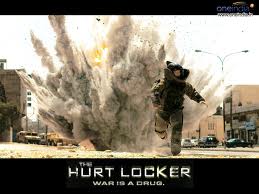
THE HURT LOCKER  (2008 - UK Certificate 15)


Jeremy Renner is the man!  I thought I would get that out there to start with, just to emphasise how much he brings to The Hurt Locker.  If they had cast somebody with less presence of character, the film would not have worked anywhere near as well, despite what other praise one could give it.  He plays Sgt. First Class William James, who steps in to lead a bomb disposal team in Iraq.  They have only a month left on their rotation, but the loss of their previous leader, Sgt. Thompson, has left them shaken, with a gap that seems hard to fill.  Sgt. James' methods and general view of his job seem, to Sgt. Sanborn and Specialist Eldridge, to be irresponsible and dangerous; this does little for Sanborne's requirement for order and discipline, and is especially threatening to the fragile Eldridge, who is already talking regularly with Colonel Cambridge, the group psychiatrist.

Kathryn Bigelow's intelligent movie, written by Mark Boal, charts the group's turbulent rotation and the psychology of the men who put their lives on the line in this way every day.  Not unlike Jarhead in its approach, it features relatively little violence for a war film, and few typical tropes of the genre. Even one scene involving a certain amount of macho-ism, in which they volunteer themselves to each others physical violence, is not actually about the violence, but about what is going on between the characters, the dynamic shifts occurring within the team, and how they view each other.  There are numerous parts that rely on subtext, or on the audience's engagement with the drama.

One central scene in particular has a lot going on with very little dialogue; this is the nature of the film in general, asking us to pay attention to the performances and story, rather than waiting for some action.  The film does not adhere to conventions very much; it is shot in a way that is suggestive of a documentary, with a feeling of not so much telling a story, but rather following a set of events.  That said, it is cinematic, with some scenes where performance and subtle, clever use of sound ratchet up the tension very well.  It is an unusual feeling, and it takes the first act of the film for us to get completely comfortable with the groove.  Once we are, however, it makes for a notably unique experience, and the fact we are focusing on a group of guys that other war films have never really looked at only adds to the freshness.

As for criticisms, there are people such as David Morse, Guy Pearce and Ralph Fiennes in this movie, but they border on "blink and you miss them" roles, which is a shame.  It could also be argued that when all is said and done, it does not feel like the film, for all its accolades, is really saying that much beyond its simple premise.  Contrary to the hyperbole surrounding it, it is not a film trying to set the world on fire, it does not have any political stance, it is not anti-war; it is simply an exciting look at the psychology of the men we follow.  The Hurt Locker has a great ending, in which the look on Renner's face, and the final shot as Bigelow brings in a track by the band Ministry to introduce the credits, perfectly underlines the point of Sgt. James' final monologue.

Not the astounding masterpiece some people might have had us think, and certainly not "the best war movie ever made", but very, very good.

4/5

 
Catch it if you like: Full Metal Jacket, Jarhead
  
ARLINGTON ROAD  (1999 - UK Certificate 15)

Jeff Bridges, Tim Robbins and Joan Cusack in a film which, had it been made a few years later, would be noted as what we now call "post-9/11", and in which Bridges is playing a role not dissimilar to his one in Blown Away with Tommy-Lee Jones.  A movie best enjoyed without knowing too much, but the long and short of it is that Bridges plays Michael Farady, who lost his wife to a botched CIA job and is now bringing up his son alone.  Upon driving home one day he rescues a young boy who has been badly injured; it turns out he is the son of the people across the road, Robbins and Cusack, and so begins a story of tense intrigue as Faraday grows more and more suspicious of his neighbours.

There are certainly things wrong with this movie, with some of it looking surprisingly "made for television", some of the supporting performances not coming off particularly well, and a couple of convenient coincidences to drive the story, but on the other hand it grips you from the opening scene, plays at some points almost like a horror, and has the courage of its convictions.  It features unsurprisingly good central performances, although at times they seem to be misdirected; we know how good these guys are, but we get the sense that perhaps director Mark Pellington wanted different performance options, and then wasn't sure how to pull it all together cohesively.  As a consequence, we have the odd scene where the performances seem oddly over-acted, although there is a valid argument that this is intentional, and required for the plot to work.  This, however, doesn't stop certain moments from feeling a bit awkward.

In any case, a film that has been a little forgotten, but if you like tense, domestic-type thrillers, this is one you should catch.

3.5/5


Catch it if you like:  Blown Away, Sleeping With the Enemy, Unlawful Entry 

Sunday, 27 January 2013

THIS WEEK: The Impossible

0 - No Redeeming Feature

1 - Poor

2 - Passable

3 - Good.  Rent it.

4 - Excellent!

5 - Must See!!


THE IMPOSSIBLE

What effectively appears to be a blockbuster disaster movie is perhaps one we would expect to come out of the Cameron or Spielberg canon, so when we see the name Juan Antonio Bayona, a director who is possibly unfamiliar to many who haven't seen The Orphanage, we are surprised and curious.  Upon closer inspection, The Impossible is in fact the incredible true account of a Spanish family's experience when the worst natural disaster Thailand has ever known hit in the form of a tsunami.  Many of us recall the disaster and its fallout, but this film takes us up close, following this one family's story, from their arrival, though their separation, to their departure.

Now there has been complaint from certain quarters that the film somehow does a disservice to the family by making them white Brits, rather than sticking to the reality that they are Spanish.  There is also claim that, by focusing on this one fortunate family's survival, the movie arrogantly disregards the experiences of those indigenous to the country, and those whose experiences were not so fortunate.  I find the prior accusation petty, and the latter ludicrous.  In casting big names Naomi Watts and Ewan McGregor in the lead roles, they simply ensure that the budget necessary for the production is more likely to be granted, and covered; the story of the family is still honoured well. The idea that somehow we ignore the plight of anybody else is just silly; certain moments in the movie, and in particular the beautifully conceived final scene, touch very well on the fact that many were not so lucky.  The title of the film itself ties in with Bayona's intent to illustrate just how rare the sort of good fortune it depicts was, and the family are shown to clearly understand this.  I am flabbergasted people are reading it any other way, to be honest.
The first ten minutes of this movie are filled with a tension; the fact we know what comes next makes the setup of Maria and Henry's great relationship with their boys, Lucas, Thomas and Simon somehow more distressing.  The next forty minutes are truly a technical miracle; never before have I been in a cinema feeling quite so overwhelmed by the depiction of a natural disaster.  Bayona uses incredible miniature sets, real water, terrifying use of sound, and superb in-camera make-up to stunning effect, forcing us to endure the entire tsunami as mother and son do.  We follow Maria and Lucas' events for about an hour before cutting over to Henry, Thomas and Simon.  I will say that there is, for me, something lacking in the second act of the film, but this is possibly because the first has blown you away to such an extent, the devastated quietness of what follows feels naturally muted.

This said, the performances carry through very well; McGregor is heartbreaking, and particular note has to be given to all the boys, who we adore pretty much on the spot.  I would also suggest keeping an eye open for Tom Holland, who plays Lucas; his arc and the maturity of his performance feels so wonderfully natural, it is a struggle to believe his only experience has been as Billy Elliott on stage, and voicing a character in 2010's Arrietty.  Naomi Watts has been nominated for a Best Actress Oscar, and whilst I suspect she will not win, I can say I have not seen her giving such a physical and emotionally draining performance, and that if you only see her in this and Eastern Promises, you might be forgiven for believing she is English.

This film does drain you; by the time you leave the movie, you do feel a little washed out, and thankful that in the end this is a story of human triumph over adversity and a celebration of spirit, rather than the dour tale it could have threatened to be.  Despite a second act lacking the kinetic force of the first, and the fact that Watts and Holland are really the more compelling characters and performances, and despite some moments where the gorgeous score does seem to teeter on being too much, overall this is a recommended experience.  I have no idea why it is not nominated for production design and sound editing, because it should wipe the floor in those categories.

4/5


At cinemas now.

Catch it if you like:  Natural disaster movies, or intense, emotional drama.

Saturday, 19 January 2013

THIS WEEK: Les Miserables/Hatchet/The Kid With a Bike/Tiny Furniture

0 - No Redeeming Feature

1 - Poor

2 - Passable

3 - Good.  Rent it.

4 - Excellent!

5 - Must See!!


Les Miserables

Les Miserables is based on the novel by Victor Hugo, which became one of the most beloved stage shows of the last century.  It is a story that starts with the simple idea of a man, Jean Valjean, who stole a loaf of bread out of desperation; his release, his breaking parole, and a moment of forgiveness sets in motion his own redemption, and the ongoing search for him by Inspector Javert.  From here the story goes on to cover a vast amount of time and culminates in the 19th Century French uprising, whilst dealing with issues of class, love, forgiveness and responsibility.  I heard it described rather well as, "a big, musical, French revolution-set version of Pay It Forward", which is not, at times, too far off the mark.

Tom Hooper comes off the back of his success with The King's Speech, and with this sets about upping his own game; Les Miserables is an all-round bigger, more daring artistic undertaking.  It seems that Hooper recognizes the stirring nature of the stage show, and that to adapt it for the screen there are two tricks necessary to play: don't fix what is not broken, and go balls-out to make it as big and dramatic as possible!  It is obvious from the opening scene, however, that he is keen to do everything with this musical that cannot be done on stage, the camera giving us an epic scope, swooping in, out and through incredible sets and landscapes.  It also gives us close-up, intimate interactions with actors as they work.  I have seen it said that this is, at times, misjudged or distracting, but I can honestly say I did not find it to be either, although I did note his refusal to play that much in mid-shot, almost, it seems, on principle.  This did not bother me, but I can understand it being frustrating to some.

Hugh Jackman is excellent in the role of Jean Valjeant; this is the bravest and best I have seen him since The Fountain.  Russell Crowe is the strangest bit of casting imaginable for a musical such as this, and yet the film contends with it rather well.  There has been some talk of Crowe being not as mean as the stage version of Javert, but it is in fact his presentation of a more complex man, struggling within himself, that makes his performance so vivid.  When you can get an audience caring this much for who is ostensibly a rather bland villain, you have done something right, and I certainly found myself caring for him as a human being rather than viewing him as simply, the bad guy.  In spite of being a bit out of his depth technically, in terms of singing voice, it is his finding of this character that somehow makes it work, and he actually delivers the song Stars with a striking beauty, a beauty which makes it one of the best scenes in the movie, and which highlights all the more why he works.  Hearing the audio is not enough; you actually have to see it, but when you do, it makes sense.  Bringing some light relief to what is otherwise a pretty heavy and dark affair are the very well cast Sacha Baron Cohen and Helena Bonham Carter, playing a couple of criminal inn-keepers, and looking like they've been dragged directly off the set of a not-yet-complete Tim Burton picture.

Anne Hathaway plays the disgraced Fantine, and she delivers from her first frame to her last, proving that she is certainly much more than just the pretty face.  When the character is at her lowest, with all hope snuffed out, she creates a new Somewhere Over The Rainbow with a barn-storming I Dreamed a Dream, a silver screen moment that is immediately classic, and which will be recalled for a long time to come as the scene in which a new bar was set for this classic song.  I very much doubt anybody will come close to affecting me with this number the way Hathaway does here; it is genuinely impossible to overstate just how powerful she is, as she hits nearly every negative emotional beat, clearly meaning every single word and tearing your heart out.  The trailer used a brief moment of her performance, but if that is all you have seen, you are not prepared, trust me.
Eddie Redmayne gives a surprisingly good turn as Marius, but it is his solo that renders us almost inconsolable.  Much like Hathaway, he throws himself into the performances with such an unexpected ferocity, you cannot fight its power.  These moments are ones in which maintaining a stiff upper lip becomes impossible, and if the lights were turned up, you would see everyone is in the same boat - falling apart becomes an utterly shameless act.  It is in these moments, also, that we forgive the odd wobbly note elsewhere, as we witness the benefit of actors being able to fully perform, rather than simply lip-synch a perfectly recorded track.  With the cast able to act their way through a scene, creating character and behaving in each moment as though they were delivering spoken dialogue, we experience the full force of the performance, warts and all.  The freedom to improvise with the live piano in their earpieces means the delivery is not always as precise as we might expect, but the payoff is the passion of it all; in this way it a bit like good jazz!

Intrinsic to the film because of the story is a sense of what I call "bittiness", one set of characters or set piece leaping to the next set of characters or set piece, which does jar at times, especially in the second half.  Why Inspector Javert is quite so intent on finding the "dangerous man" Valjean, as to search for years, is something never really understood, and it makes for a frustrating sort of convenience that they are continually running into each other for the sake of driving the story forward.  It will take some a little while to settle into the groove and feel of the film; something about everyone singing everything is a tad alienating, but we do reach a point where it settles in nicely.  This said, a few scenes never get around feeling a bit awkward in their staging, which was an unfortunate, but only occasional issue for me.  I must also admit that, where most of the music and songs are powerful, dramatic, raucous, exciting, and in one case even amusing, I could not help but notice some moments that don't work as well, with at least one song that really, for me, couldn't be over soon enough.  I do, of course, understand this may be a case of taste.

The thing about this movie is, even at its weakest moments, there is an overarching feeling that everyone loves what they are there for, and that they are giving heart and soul to make it as staggering as they can; they intend to make you experience something worth every penny paid for admission.  The more full-on, risky and daring it is, the more we can't help but think, "Like it or not, this is what cinema is all about!"  In spite of the individual issues we may pick out, this behemoth production rocks you at a core level; it is rough around the edges, but it makes virtues of most of its flaws.  Technically not the five-star show people know, but its bravery, gusto, and full-on determination to stir your spirits wipe out the negatives and power it through as a film, nay an experience, I found myself enjoying as though it were a masterpiece.  Do not be surprised if some people cheer at the end, or you find yourself, at the final ensemble scene with goosebumps, wanting to start your own revolution. 

4/5


At cinemas now.

Catch it if you like: The King's Speech, or the prospect of a risky musical spectacle with balls!

HATCHET

Adam Green would go on to write and direct a film called Frozen, which I recommend, but before that he made this cult classic send up of the B-Movie horror.  Two guys find themselves stuck in the middle of nowhere with a group of holiday makers, being hunted by a ghost of the disfigured character named Victor Crowley, who, stuck with the rage of the night he was burned to death, is out to kill everyone who crosses his path.  Hatchet tells of the group's gradual demise in typical slasher fashion.

Opening with a sequence starring the legend Robert Englund (Freddy), following it up with a credit sequence set to Marilyn Manson's This Is The New Shit, and featuring a cameo by the great Tony Todd (Candyman), it is quite clear what Green's intentions with the film are; this is low budget, ridiculous, well scripted nonsense, full to the brim with bad cliche, and it is one of the most fun splatter-fests I've seen for a while.  It is undeniably bad, but what elevates it is the sense that Green is so up on the genre, and so in love with the tropes, that he has set out to have some fun with it, hence the laugh out loud dialogue and the film's overload of self-aware irony.  Make no mistake, this is no Wes Craven, it is more Romero with a knowing twist of self-ridicule.  Granted, it does lose steam in its final third, but if you know what you're watching, and are not looking for something trying to be good, you could have a great time with this.  I know I did.

3/5


Catch it if you like:  The Cabin In The Woods, The Evil Dead, Scream, and B-movie schlock horror.

THE KID WITH A BIKE

Very little to say about this film, not because it's not good, but because it defies that much of a review by its nature.  A troubled young boy clings tirelessly to the idea that he can be with his father and along the way discovers what real love and a parent should be.  Somehow it all revolves around his bike.  Typical of French cinema really, it is not without its charm and it whizzes by nicely.  Cecile De France, who some may know as the central character in the flawed but fascinating Switchblade Romance, gives a typically fine performance as a woman who takes on responsibility for the boy Cyril, inexplicable as it may be, and Thomas Doret is very good as the titular kid himself.  I cannot say I did not enjoy it, but there is a sense that there was little concern for fleshing that much out at the writing stage, and it never really resolves that.  The film also comes to a swift close which, whilst not a bad place for the story to find its end, does leave it feeling somehow unfinished.  All-in-all a humble and charming slice of French drama, but nothing to write home about.

3/5


TINY FURNITURE 

Lena Dunham is a writer with a future; writing, directing and starring in a film is a trick only occasionally pulled off well by the big boys not preceded by their ego, but watching Tiny Furniture, you are aware she has some chops.  A quick look at her IMDB page confirms the suspicion that she has had, and continues to gain, experience in many artistic fields, from the writing to editing to acting and now, directing.  Here she plays Aura, a college graduate who returns to live with her mother and sister while she works out what to do with herself.  This entails meeting a minor internet star and letting him stay at their home while her family are away, becoming a day hostess for a restaurant that never seems to have any custom, and unwittingly burning every bridge that could be important to her.

An off-beat drama featuring her very own mother and sister, pretty much playing themselves, it turns out, this feels like a Woody Allen piece.  If this is evidence to go by, Dunham has some way to go before she makes a truly compelling film, however, given its shoestring budget and low-key nature, it is not without some charm and good ideas.  It is also no doubt quite reflective of her own family, her mother actually having an artistic career not unlike the one presented in the film which, given some of the scenes in the film, make me wonder just how biographical the whole thing is.  Some of the drama works, some of the humour works, and the final scene is a thoughtful footnote.  Tiny Furniture, as the title suggests, is about small things, which turn out to be quite big things.  Not wholly successful, but worth a look.

2.5 / 5


Catch it if you like: Ghost World and the like.

Saturday, 12 January 2013

THIS WEEK: Silver Linings Playbook/Shame/Coriolanus

0 - No Redeeming Feature

1 - Poor

2 - Passable

3 - Good.  Rent it.

4 - Full Price

5 - Must See!


SILVER LININGS PLAYBOOK

It must be said that despite its plaudits, The Fighter is not a film that was particularly impressive to me, and David O. Russell is not a director I can safely rely on for a guaranteed great film experience.  Likewise for Bradley Cooper, who has proven himself as a perfectly fine leading man previously, but is most notable for his role in films I don't rate.  Add to this the fact that one of the greatest screen actors of all time, Robert De Niro, has made similar-looking film choices in recent years that were questionable, and that the marketing campaign for Silver Linings Playbook seemed to have it setup as a rather forgettable rom-com, set awkwardly around the subject of mental illness, and you might understand my concern going in.  I am therefore happy to say that not only was I pleasantly surprised, but that I actually put it straight in as one of my favourite films of 2012!

The film centres around Pat, who suffers a bipolar disorder and who has, due to an unfortunate incident involving his wife and her lover, recently spent eight months rehabilitating at a facility.  He is brought home to live with his parents while he gets back on his feet, but is convinced he can make contact with his wife by means of a letter and that everything will be back to how it was, despite the fact she has had a restraining order taken out against him.. Exactly as you might expect from the synopsis, it is very much a story which, in the wrong hands, could have become a debacle of bad taste; as it is, Russell marshals it all rather well and creates a solid, engaging drama.

Now let's not get carried away, it is not a masterpiece; some notable technical errors, including at least one scene that bordered on misguided and farcical, though admittedly well staged, do hold it back.  It is also, in the end, little more than an extremely off-beat romance; even in dealing with mental illness, and addressing issues like the ill-judgement of people affected, it still has nowhere near the same important resonance as, say, One Flew Over The Cuckoo's Nest.  Beyond this, however, there is a lot to be admired, and it starts with the grace with which it handles the subject.  This seems to stem from the fact that the author has great respect for the characters, and that Russell apparently has a personal relationship with the subject through his family.  I must say it shows; every character has some relationship with mental disorder, and though there are moments of lightness, the humorous edge of the film grows organically from the story, in the way it would in reality, rather than being forced.  We are never made to feel we are complicit in pointing and laughing; on the contrary, I found every single character, major or minor, to be very well drawn and someone I felt I could believe in and in whom I could invest emotionally.

It is also a film that seems determined to defy quite a lot of convention; just as you suspect certain plot points or moments are about to go one way, some might say the Hollywood way, it in fact goes somewhere else, on one hand surprising you, and on another carving a deeper sense of empathy and realism.  To cite examples, watch out for a scene in which Pat gets into a real physical fight with his father, or his discussions with his therapist; moments like these, due to their sense of realism, engage you all the more with the characters, and make them so much more than mildly humorous cliches.  It does, of course, go into Hollywood land eventually, but by this point, such has been the good judgement of the movie in nearly every way, you find yourself enjoying it rather than being cynical.  De Niro's reaction to the "big moment" in the finale, as well as the moment itself, is so wonderfully, awkwardly, and realistically amusing, it is one of a few genuine laugh-out-loud moments, and the scene also features possibly my favourite line in the movie, by an extra, no less!

Much has been said for the performances, and rightly so.  From the smaller roles, such as the one filled by Chris Tucker, to the major, I don't think I can find a weak link; if anything, it is their drawing I would like to have seen more of, rather than better performances.  Jennifer Lawrence is exactly the effortless performer I have come to expect, and I only take this opportunity to recommend to everybody a film called Winter's Bone which, whilst not perfect, features a quiet, intense, star-making performance from a younger Lawrence.  When Bradley Cooper is given good material, he is a terrific lead, and I just wonder to what degree he sought advice from his on-screen father De Niro who, forty years earlier, may have easily walked away with an Oscar for a performance Cooper is here required to give.  Speaking of De Niro, it is good to see his chops not lost and that he still owns his time on screen; it is fair to say I have not seen him this good for a while, and it is a joy to watch him back on form.  Best Supporting Actor nomination, ahoy!

For me, one of the big surprises of 2012, and in the strangest way, the best feel-good film I have seen for some time, Silver Linings Playbook is an engaging, well-crafted piece of storytelling.  Some of its ideas are ultimately a bit above its station, but it is still a wonderful two hours.

At cinemas now

4/5


Catch it if you like: Good Will Hunting, One Flew Over The Cuckoo's Nest. 

SHAME 

I was aware of Steve McQueen as an artist, whose work I even recall studying at GCSE here in the UK, but it was his debut feature Hunger that confirmed him as a serious film maker.  Hunger also confirmed the suspicion I had roused by the movie Eden Lake, that Michael Fassbender is a screen force who demands some real attention.  Here in McQueen's second feature he plays Brandon, a thirty-something living on his own in New York, whose professional life remains steady, while his personal one is absolutely driven by a need for sexual gratification.  Whether it be through pornography, random women like the one at a bar his boss wants to take home, prostitutes, or simply regular trips to the bathroom to have a friendly get-together with his hand, he is in need of release through sex.  To understand a film is about such a topic, two things come to mind: it sounds funny, and even if it is not, it is undoubtedly going to be a piece of erotica not far removed from pornography.  In fact Shame is neither funny or erotic.  It is explicit, but that is to be expected.  What it is actually about is far more interesting; a sincere examination of a lonely, lost soul in a vast, faceless city, and the need, and importantly the lack of desire, to find something more, to feel connected, to feel human.  This need seems highlighted when Brandon's sister arrives in the form of the terrific Carey Mulligan, their fraught relationship and her attempt to connect with him managing to pull his life apart and force his self-reflection.

This is a movie I did not get to writing about straight away, as I felt the need to let it settle before feeling I knew what I wanted to say about it.  With that being done, here it is.  There is a lot to be admired about this film, and here is where the problems also begin; it is a film to be admired in its bits and pieces, but not embraced as a whole.  When it gets dynamic and dramatically gripping, it is primarily because Fassbender and Mulligan do outstanding work with what they are given; they have a terrific chemistry as siblings who are both disturbed in their own way, and particularly in scenes where a disturbed past is hinted at, they perform expertly.  At no point are we told anything, and in the end it is down to us to consider their potentially unsavory history.  This has two functions: the absolute lack of exposition between characters who already know everything about one another keeps it realistic, and the sense that we never really get to know them properly keeps them devoid of something vital, preventing them from being utterly human, which is of course the point.  It must be said, as superb as Mulligan is, she is not given a great deal to do overall, and so it becomes very much Fassbender's film in terms of performance.  Once you get around the fact that you see a reasonable amount of his penis in this movie, you can easily see why many eyes were on him at the Oscars last year; Brandon is a difficult, quiet, damaged and complicated man to play, and the fact the majority of our understanding comes only from the actor's expressions and behaviour is impressive; that we actually see a character development and arc in Brandon is testament to Fassbender's talent.  As was shown in McQueen's debut, he clearly works well with the man.
  
The film has a stunning score, which is arguably the best thing about it.  Sounding like Hans Zimmer half asleep, its haunting nature captures perfectly the sad tone of disconnection, loneliness, and ultimately the apparent futility of the effort to change the situation.

McQueen has an undeniable eye for excellent composition, which is no surprise; as an artist he has a keen understanding of how powerful an image can be, how one tableau can speak a hundred words, and that is very obvious throughout.  The whole thing is shot with they eye of a man who is first and foremost an artist, so there is no denying the film's urban beauty.  Such is his insistence, however, on getting across the points through visuals and long, protracted scenes in which so much is unsaid, or so much is about the internal, and which sometimes border on overdone, that I found myself often realizing I might do just as well to read a memoir of this man, rather than watch it be played out.  It looks and feels like a book.  In terms of the story unfolding, it does so in quite a stagy way at times, and this highlights an issue McQueen has not really overcome with either film, which is his inability to drive forward with a narrative.  His desire to put individual scenes together and create moments is a priority, and so the drive of the film seems laboured.  This said, staging of said moments is impressive, much of the film having an almost Kubrick feel of precision, keeping us intentionally somewhat removed from the characters, which, given the subject matter, brings about an obvious comparison to Eyes Wide Shut.  This is true for all scenes barring one towards the end, which seems decidedly unrealistic; set against the impressive realism of the rest of the film, this was strange and took me out of it. 

I consider Shame rather flawed, and can't say I liked it, yet I found it compelling and moving; in this way it is a strange movie to pass a clear verdict on.  McQueen is very confident in his transition to film; his work thus far is admirable and does have a power, but in the end Shame equals, for me, less than the sum of its parts.  To each their own, of course, but I would suggest you can see some similar issues tackled, with perhaps more narrative flow, and far less handsomely, in work like Intimacy with Mark Rylance and Kerry Fox, and Open Your Eyes with Clive Owen and Alan Rickman.

On DVD/Blu-Ray now.

3/5


Catch it if you like: Eyes Wide Shut, Hunger, Intimacy, Open Your Eyes.

CORIOLANUS

Ralph Feinnes takes one of William Shakespeare's lesser known, longer plays, and adapts it for the big screen.  Those familiar with the play will argue it has been too cut down, and some purists will decry any modern adaption, almost on principle, it seems.  Just as with Romeo and Juliet, though, we see the beauty of Shakespeare's poetry pushed to the front, delivered with much power by a cast featuring some surprising players.

Most notable by the fact he should seem out of place is Gerard Butler, who actually fits right in as Aufidius.  He is an interesting character, he respects his enemy, and wants to overthrow him; both facets have to be made clear and this is a dramatic task Butler rises to rather well.  Also giving a surprisingly exciting turn is James Nesbitt, as an angered Tribune.  Alongside them is a host of far more immediately comfortable-looking actors, including Jessica Chastain, Brian Cox, and Vanessa Redgrave, who almost steals the piece as Volumnia.  Shakespeare did love his strong females, and she is no exception.

Unlike Baz Luhrmann's bombastic take on the star-crossed lovers, Coriolanus is treated with a far sterner hand; you can almost feel Feinnes scowling from behind, as well as in front of, the camera!  What a performance he gives, though, intense and frightening on one hand, spitting the vitriolic monologues with relish, yet just as convincing when playing sheepish and pathetic under his mother's authority.  If you like to hear this stuff acted out, this is definitely a treat of a movie.  The reason for the firm handling is, of course, that this play has no sense of frivolity or fun about it; this is an all round meaner piece about social upheaval, prompted by a Roman warrior who is too proud of his position to care about being a voice for the common man.  The commoners revolt and banish him from Rome, we see his loyalties easily corrupted by his pride, and we watch him turn to his life-long enemy in order that he may attack his people.  The tension heightens, and we cannot help but understand Feinnes' choice to make it; one cannot fail to see its relevance today.  The inclusion of familiar BBC faces playing their part as news readers and talking heads in the piece is a smart move, really bringing the drama into modern day and making it feel all the more familiar and relevant.

With the good comes some of the bad, of course; Feinnes' lack of experience in handling action sequences shows, the city of Rome appears to consist of very few people, which does not help give weight to the idea that there is an uprising, and there is a sense of the film petering out rather than ending with the real dramatic bang one might expect.  The power of the writing, however, an exciting use of music, and the principal performances make it a compelling adaption of a play that illustrates how relevant the Bard remains.


On DVD/Blu-Ray now.

3.5 / 5


Catch it if you like:  Romeo and Juliet, solid Shakespeare adaptions.

Sunday, 6 January 2013

THIS WEEK: Pitch Perfect/Quartet/Even The Rain/The Prey (Le Proie)

0 - No Redeeming Feature
1 - Poor
2 - Passable
3 - Good.  Rent it.
4 - Full Price
5 - Must See!

The new year brings with it a host of promising films and here follows my take on one of the first releases of 2013, along with no less than three previously unwatched movies.  Yes, I did well this week.

PITCH PERFECT

Anna Kendrick is coming to prove her worth with her last few film choices; whether one likes the movies or not, she is undeniably a strong screen presence and an actress who, like Pattinson, appears to have the talent to get out from under the Twilight shadow in the long-run.  Here she plays Beca, a woman who joins Barden Universtiy with one goal, to become a DJ.  Upon arrival she is swiftly accosted in the shower by Aubrey, who hears her singing voice, and is almost ordered to join the all-girl singing group The Bellas.  The Bellas compete each year in the campus singing competition, and it is clear that this time they have more to overcome than just their male competition, The Treblemakers.

It featuring a lot of teens straight out of performing arts, musical set pieces, witty one-liners, and is directed by Jason Moore, responsible for episodes of Dawson's Creek and One Tree Hill, among others.  The Glee similarity is all too clear, and Moore's TV roots do show; given that, there is no denying the trepidation I felt walking in.  Much to my surprise, then, and I would by lying to say otherwise, I found myself entertained.  Yes, it is exactly what you would expect when you look at the poster, not much more or less, but it is raised above the average by the musical elements genuinely working well, the refreshing look at the girl group as human beings with different personalities, rather than as being simply 'mean girls', and a strong sense that Moore understands its intended audience.  This is perhaps best reflected by the choice to heavily reference The Breakfast Club in the story; many who watch Pitch Perfect may not have seen it, but could well be encouraged to go take a look, and understand the use of this coming-of-age classic as a reference point due to its influence.  It is not to say the two are at all in the same league, but it is to say the movie remains arguably the most iconic of the field Pitch Perfect is aiming to be included in.  The narrative and character development is fairly weak and there is no getting around the fact it is clearly at its best when being funny or breaking out the music action, but it is what it is and it does the job well.

Most people will recognise the standout element of the film, the thing most people will talk about, as Bridesmaids' Rebel Wilson as Fat Amy; she is intentionally given some of the best lines and she delivers superbly.  The film is worth watching for her!  Pitch Perfect will do exactly what we expect, be popular for a while, particularly with the crowd into this sort of movie, and then gradually be forgotten, but Wilson is a comedy gem of the future; she is here to stay!

At cinemas now.

3/5

 QUARTET
Dustin Hoffman directs what is otherwise a quintessentially British play-turned-film. A quartet of yesteryear's professional opera stars are asked to perform again at a gala, which will save the retirement home in which they now live. You might be forgiven for assuming this will end up being a stuffy piece, about a boring topic, which will hold only the interest of a select audience, but you would be wrong on all counts.

Quartet's winning stroke is the casting; I could not imagine a better line-up of four performances I would rather watch.  Not one of the principal cast drop the ball and I am hard pushed to choose any actor's performance over another; this is supported by the fact they are given such humorous, touching, and most importantly, real dialogue to deliver and honest emotion to play.  The situation that emerges and how it plays out all feels so natural, there is no avoiding being drawn in, entertained, and ultimately moved by it.

The film is no longer than it needs to be, rather dry with its humour, touching with its sentimentality, without over-egging it, and well observed in its detailing of the people you are watching.  You come to realise, fairly quickly, that what is important is not whether you enjoy the subject of the music, or whether you are of an age that you will naturally relate to the characters, but just that you understand the frame of reference through which the touching story of love and regrets plays out.  It is not a film to set the world on fire, and will likely be swiftly overshadowed, but it does what it does very well.  It is a touching, enjoyable movie for all, which will likely find its most loyal audience outside of the cinema, on a lazy Sunday afternoon.

At cinemas now

3.5 / 5

EVEN THE RAIN

An almost perfect drama, which beautifully balances the story of a film being made about exploitation of the New World with exploitation in the real world.  A film being made, about Columbus' discovery of the New World 500 years ago, enters turmoil as around the film makers the people of Bolivia enter into a volatile urban war over water.  In their efforts to complete what they consider an important movie no matter what, the question is whether the film makers are becoming a cog in the very machine their film decries?

It takes perhaps half an hour to settle into a groove, and with it being a foreign language movie, I might understand some people losing interest and switching offThis is a shame, as Even The Rain actually rewards patience; it becomes an extremely engaging drama about politics AND people; it is provocative, exciting, very well put together, and is easily among my top ten of 2010.  Telling a tremendous story and featuring a great screen presence in Luis Tosar as pragmatic producer Costa, this is a superb movie all should see.

Get it on DVD/Blu-Ray now.

4.5 / 5

Catch it if you like:  Che, Fair Game, The Hurt Locker, Lebanon.

THE PREY (LE PROIE)

Released in 2012 and totally overlooked, I won't say much about this except it is another typically impressive slice of French thriller cinema, looking like Hitchcock directing a Tarantino screenplay, if you can imagine such a thing.  Primarily a cat-and-mouse chase, it is a bit let down by its odd score, which does feel a bit Pink Panther at times, but it also features some terrific actions sequences, a wonderful central performance from Albert Dupontel, who cinephiles will be likely to recognise, and it is all underpinned by an exciting idea that feels like a Harlen Coben novel.  Worth checking out.

On DVD/Blu-Ray

3.5 / 5