0 - No Redeeming Feature
1 - Poor
2 - Passable
3 - Good. Rent it.
4 - Excellent!
5 - Must See!!
A week in which all I watched was movies that dealt with terrorism and the war against it, in various forms. All four are looked at here.
ZERO DARK THIRTY (2013 - UK Certificate 15)
Following up on the success of
The Hurt Locker, which you will see reviewed below, Kathryn Bigelow and screenwriter Mark Boal deliver their controversial depiction of "the greatest manhunt in history" with
Zero Dark Thirty. Jessica Chastain is Maya, the female CIA operative who, if the source is to be believed, is the one who kicked her male counterparts into action, and the key component to the capture of Osama Bin Laden. We
will of course never know how reliable and historically accurate the
finer details of this story are, we are just required to trust that the film makers are as truthful as they can be. This might have been
tougher to do if the movie was a blindly patriotic, flag waving,
gung-ho, pro-America one, but it refuses to be that simple at any point, which
disarms any sense of mistrust one might have of the piece. This is a trait that carries right through the movie generally, with Bigelow far more interested in chronicling the events objectively than
providing a commentary.
The
main hot political potato that has arisen with the film is the
subject of whether or not it champions torture, and whether it was, in this case, successful or not as a means to obtain
information. For
me, there are two very straightforward things to say
on the matter. Firstly, and backing up my feeling that the film maker remains at a moral remove from the subject, I am not entirely sure what the people who are
upset about it wanted; torture occurred regardless of
our
feelings about it, and as Bigelow has pointed out, to
not depict this part of the story would be dishonest. Secondly, the very fact there
is a raging debate as to whether the movie does or does not champion its use is evidence, in
itself,
that it does
not make it a clean-cut, black and white case. Unlike other reviews, I
will not spoil the movie by mentioning the crux of a key plot point in
relation to the matter, but it could be well argued that the film remains deliberately neutral
on it. Boal and Bigelow put the subject out there for debate,
seemingly playing devil's advocate in terms of their own feelings; I
suspect they felt it would be wrong to imprint their
personal stance on a film such as this.
This film is larger in scope than
The Hurt Locker, but they
actually share a lot of DNA; both are timely works about the war, and
both are notable for examining the psychology of their central
character, the big difference being that one film is set in the midst of
the hot zone and about a group dynamic, while the other shows us a war
which becomes almost personal, and is fought from behind a desk. Where
The Hurt Locker had the freedom afforded it by not being based on a set of events,
Zero Dark Thirty adheres very strictly to a specific
set of events, namely the zigs, zags and frustrating dead ends that were the decade-long hunt for the world's most wanted terrorist.
This is, at once, a strength
and a weakness of the movie; the film focuses on detailing one event after another, with a cold precision and little character development. Thankfully, the movie is crafted in such a way that, despite knowing how it ends, as with
Apollo 13, we find ourselves gripped by the details of the hows, whys and wherefores. Nevertheless, whilst the who's who of a cast all give believable performances, there is generally the sense that you are simply a fly on the wall, not getting to know these people, but rather watching things play out, in the moment. There are two exceptions to this, one being Dan, the expert in "enhanced interrogation techniques", who in another context you feel you could like. He is played by the fantastic Jason Clarke, previously of
Lawless; his lack of nomination for Best Supporting Actor at the Oscars is a
huge oversight. The other is Maya herself; Chastain plays a woman who does not give much away, and so it is understandable that, to some, her performance seems flat, and certainly not worthy of her Oscar nomination. I will not say she deserves to win it, but I definitely disagree that it is a
flat performance; on the contrary, she actually has some rather amusing and deftly written dialogue, which is a pleasant surprise, and I find the subtle shifts in her character's psychology, the growth of her obsession, even in the face of people telling her to let it go, to be one of the most compelling elements of the film.
And it is on her performance the film takes its final bow;
Zero Dark Thirty goes out, not with a bang, but on a downbeat. The final half hour of the movie is a well-executed, realistic depiction of the raid of the house and the killing of Osama, and yet we
miss the drama of the preceding two hours. Could this be the point? Maya's tears and final exhalation are of what? Relief or joy? She's not smiling. Sadness? Understanding of loss? Perhaps it is something not so easily captured in just one word or phrase, but one things is for sure, you know you are looking at a character who, like us, found that the chase became more important than the objective, and only now has come to realize that the last decade of her life has yielded nothing; no friends, no love, no family, no real home, nothing but one man's death. At one point in the movie, upon being asked what she has done for the CIA other than this, she has to answer: "Nothing, I have done nothing else."
You do not leave this film, with its quiet closing credit score, feeling at ease or like it celebrates anything, other than perhaps the bravery of the men who put their life on the line for an important job; the movie actually leaves us with an unexpected feeling of hollowness. This is a thoughtful movie, put together by somebody who understands it
is not a simple subject to relay; it doesn't
tell the audience what to think, and there are those who might not like or admit that. Those of the
general public passing judgement on a subject about which they know
little,
especially when they have not even bothered to see the
film, are, I believe, bandwagon jumpers who like the sound of their
own, mostly ill-informed ramblings, and who should perhaps see the film first.
4/5
Catch it if you like:
The Hurt Locker, Zodiac.
FOUR LIONS (2010 - UK Certificate 15)
British radio and TV anarchist Christopher Morris penned and directed
Four Lions, an
absurd send up of a UK terror cell, who want to launch an attack in
London, England that will "echo through the ages." Just a few problems,
namely, the smartest of them is misguided, one is too scared and
gormless to
be a terrorist, one is a moron, and one, in his own words, "doesn't really know what he is doing."
The
principal cast are excellent; headed by Riz Ahmed and including the
wonderful Nigel Lindsay, who has tried his hand at pretty much
everything, and Kayvan Novak, perhaps best know here in the UK as the
Fonejacker, they do a great job of striking the balance between simple
send-up and humanizing the wannabe terrorists. The biggest surprise is
that, despite some genuinely laugh out loud moments and very deftly
written dialogue, Chris Morris goes surprisingly tame with this piece. A
man who has famously had his work both revered and frowned upon for
"going too far", a man for whom there is apparently no line of decency
when it comes to making us laugh with uncomfortable subject matter, here
he stays fairly broad with the humour. This is not necessarily a bad
thing, but Chris Morris fans, or people after something with more of a
bite, may be disappointed.
Nevertheless, if you can handle the fact that this is a comedy about terrorism, there is a lot of fun to be had here.
3.5 / 5
Catch it if you like: Channel 4's
Brass Eye, The Day Today, and
Jam.
THE HURT LOCKER (2008 - UK Certificate 15)
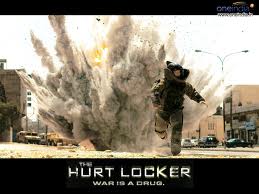
Jeremy Renner is the man! I thought I would get that out there to start
with, just to emphasise how much he brings to
The Hurt Locker. If they had cast somebody with less presence of
character, the film would not have worked anywhere near as well,
despite what other praise one could give it. He plays Sgt. First Class William James, who steps in to lead a bomb disposal team in
Iraq. They have only a month left on their rotation, but the loss of
their previous leader, Sgt. Thompson, has left them shaken, with a gap
that seems hard to fill. Sgt. James' methods and general view of his
job seem, to Sgt. Sanborn and Specialist Eldridge, to be irresponsible and
dangerous; this does little for Sanborne's requirement for order and
discipline, and is especially threatening to the fragile Eldridge, who
is already talking regularly with Colonel Cambridge, the group
psychiatrist.
Kathryn
Bigelow's intelligent movie, written by Mark Boal, charts the group's
turbulent rotation and the psychology of the men who put their lives on
the line in this way every day. Not unlike
Jarhead in its approach, it features relatively little violence
for a war film, and few typical tropes of the genre. Even one scene involving
a certain amount of macho-ism, in which they volunteer themselves to each others physical violence, is not
actually about the violence, but about what is going on between
the characters, the dynamic shifts occurring within the team, and how
they view each other. There are numerous parts that rely on subtext, or on the
audience's engagement with the drama.
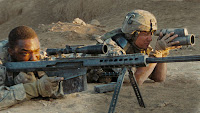
One central scene in particular has a
lot going
on with very
little dialogue; this is the nature of the film in general, asking us
to pay attention to the performances and story, rather than waiting for
some action. The film does not adhere to conventions very much; it is
shot in a way
that is
suggestive of a documentary, with a feeling of not so much
telling a story, but rather following a set of events. That said, it is
cinematic, with some scenes where performance and subtle, clever use of
sound ratchet up the tension very well. It is an unusual feeling, and
it takes the first act of the film for us to get completely comfortable
with the groove. Once we are, however, it makes for a notably unique
experience, and the fact we are focusing on a group of guys that other
war films have never really looked at only adds to the freshness.
As for criticisms, there are people such as David Morse, Guy Pearce and
Ralph Fiennes in this movie, but they border on "blink and you miss
them" roles, which is a shame. It could also be argued that when all is
said and done, it does not feel like the film, for all its accolades,
is really
saying that much beyond its simple premise. Contrary to
the hyperbole surrounding it, it is not a film trying to set the world
on fire, it does not have any political stance, it is not anti-war; it is simply an exciting look at the psychology of the men
we follow.
The Hurt Locker has a great ending, in which the look on Renner's face, and the final
shot as Bigelow brings in a track by the band Ministry to introduce the
credits, perfectly underlines the point of Sgt. James' final monologue.
Not the astounding masterpiece some people might have had us think, and
certainly
not "the best war movie ever made", but very, very good.
4/5
Catch it if you like:
Full Metal Jacket, Jarhead
ARLINGTON ROAD (1999 - UK Certificate 15)
Jeff Bridges, Tim Robbins and Joan Cusack in a film which, had it been made a few years later, would be noted as what we now call "post-9/11", and in which Bridges is playing a role not dissimilar to his one in
Blown Away with Tommy-Lee Jones. A movie best enjoyed without knowing too much, but the long and short of it is that Bridges plays Michael Farady, who lost his wife to a botched CIA job and is now bringing up his son alone. Upon driving home one day he rescues a young boy who has been badly injured; it turns out he is the son of the people across the road, Robbins and Cusack, and so begins a story of tense intrigue as Faraday grows more and more suspicious of his neighbours.

There are certainly things wrong with this movie, with some of it looking surprisingly "made for television", some of the supporting performances not coming off particularly well, and a couple of convenient coincidences to drive the story, but on the other hand it grips you from the opening scene, plays at some points almost like a horror, and has the courage of its convictions. It features unsurprisingly good central performances, although at times they seem to be misdirected; we know how good these guys are, but we get the sense that perhaps director Mark Pellington wanted different performance options, and then wasn't sure how to pull it all together cohesively. As a consequence, we have the odd scene where the performances seem oddly over-acted, although there is a valid argument that this is intentional, and required for the plot to work. This, however, doesn't stop certain moments from feeling a bit awkward.

In any case, a film that has been a little forgotten, but if you like tense, domestic-type thrillers, this is one you should catch.
3.5/5
Catch it if you like:
Blown Away, Sleeping With the Enemy, Unlawful Entry


 Each timeline is contracted or dilated to
give everybody equal measure and importance, whilst staying true to and very
much in their situation. Yes, this means we’re kept on our toes; we
have moments of confusion as timelines cross over, and we see the same thing
happening from another point of view, but as we head into the finale, as well
as the aforementioned tension and release (which is just exciting cinema), we
also get to see how, despite very different perspectives, everyone is working
together, and how sacrifice and struggle for duty is par for the course for
all involved, whether other people know it or not. It is important that we, the audience,
recognise this bigger picture, and as everything clicks together in an emotive final convergence of efforts, we
not only see the justification for the techniques adopted, but struggle to imagine
the story told another way. That is, at
least, without going down a standard route, with objective storytelling
employed.
Each timeline is contracted or dilated to
give everybody equal measure and importance, whilst staying true to and very
much in their situation. Yes, this means we’re kept on our toes; we
have moments of confusion as timelines cross over, and we see the same thing
happening from another point of view, but as we head into the finale, as well
as the aforementioned tension and release (which is just exciting cinema), we
also get to see how, despite very different perspectives, everyone is working
together, and how sacrifice and struggle for duty is par for the course for
all involved, whether other people know it or not. It is important that we, the audience,
recognise this bigger picture, and as everything clicks together in an emotive final convergence of efforts, we
not only see the justification for the techniques adopted, but struggle to imagine
the story told another way. That is, at
least, without going down a standard route, with objective storytelling
employed. 


