Search This Blog

Showing posts with label cinema. Show all posts

Monday, 31 July 2017

DUNKIRK


Summer is usually too early for this, but with his majestic, assaultive Dunkirk, visionary director Christopher Nolan has crashed his way into an Oscars race most of us were unaware had already started!

It is 1940, 400,000 allied troops are cornered and cut off on the beaches of Dunkirk, and with the enemy closing in, with no cover or defence, they await annihilation or a miracle.  Many should be familiar with the story of the Dunkirk evacuation, so the outcome to which we are headed may not be a surprise.  For those going in cold, however, if you need more than this information to get on board with a film, this one may not be for you; a brief setup via title cards is all Nolan is willing to provide before dropping us into hell.  There are no backstories, description of home or family lives; no cuts to politicians explaining things, no generals debating around maps, and barely a memorable name among our company.  It should be noted, this is not some major directorial mis-step, but an obviously conscious choice, and if you don’t “get it”, I’m afraid this is on you.  Serving a notion not dissimilar to that of his first hit, Memento, we experience the moment as the characters do, without unnecessary exposition, or dialogue!  Indeed, this proves quite the departure for Nolan; there is a lot here that owes more to silent cinema than anything else, but like Hitchcock, Lean or Kubrick, his images often say everything: A soldier giving up hope, walking into the sea in a sad effort to swim to a visible home, a nod of the head or look on the face of a masterly actor, or a lingering shot on the lock of a boat cabin door give us all we need.

An opening frame invites us to join a small group of helpless, stranded soldiers as they pick from the air enemy propaganda, informing them they are surrounded.  Next, the loudest onslaught of gunfire kicks the film into another gear!  We are given as much pause for thought as the soldiers we follow.  We run with Tommy, played by a Fionn Whitehead, and like him, we are aware of comrades falling dead next to us, but it is all panic and no time; we will lament their loss later.  Set to the ticking of a watch, we feel Tommy’s heart pounding with ours, (in IMAX, quite literally!), and we know the tone for this audacious movie has been set.  It is honestly quite a terrifying opening sequence, and we sense the next 90 minutes is likely to be an anxious ride.  And it certainly proves to be the case; do not expect to sit still with this one, and try to remember how to breathe as you watch the attempts at survival by these young men, with Nolan allowing for very little let-up in pace.

 We see the event from different perspectives and, it will surprise few Nolan fans, from within different time frames.  Right now, not many a director can build tension and momentum like Nolan, with what he calls the “snowball effect”, and here there is no exception.  The jumping to and from different characters’ point of view, the corkscrew impression created by the editing, chaos layered upon chaos, events echoed and accompanied by Hans Zimmer’s Shepherd’s Tones and appropriately persistent, unrelenting, sometimes suffocating music, acting at times more like sound design; it all results in a constant rise in tension, again akin to Hitchcock, to the point of almost being exhaustive.  At less than two hours, this whole thing feels like the last act of one of Nolan’s previous efforts, and there is certainly the sense at the end, with the catharsis found, that we may not have been able to handle much more.

We saw this "snowball effect" previously, put to particularly effective use in Inception, but here, it serves another purpose, and perhaps a higher one, which I suspect might be lost on some of its harsher critics.   The “Miracle of Dunkirk” is a grand story, with every soldier, every pilot, and every civilian having their own point of view.  Nolan wants us to build a picture of the event purely through subjective experience, so of course we spend a tiring, slowly cut week with the terrified boys.  Of course we spend a desperate day with a fisherman, as he and his familial crew sail their way into action.  Lastly, given the fuel constraints of the RAF, whose decisions had to be immediate and impulsive, always making a choice between defending the beach or getting home, why would we spend any more that an edge-of-your-seat, quickly-cut hour in the cockpit of a Spitfire, as they do their duty, entering into dogfights to keep the German aircrafts at bay?    


Each timeline is contracted or dilated to give everybody equal measure and importance, whilst staying true to and very much in their situation.  Yes, this means we’re kept on our toes; we have moments of confusion as timelines cross over, and we see the same thing happening from another point of view, but as we head into the finale, as well as the aforementioned tension and release (which is just exciting cinema), we also get to see how, despite very different perspectives, everyone is working together, and how sacrifice and struggle for duty is par for the course for all involved, whether other people know it or not.  It is important that we, the audience, recognise this bigger picture, and as everything clicks together in an emotive final convergence of efforts, we not only see the justification for the techniques adopted, but struggle to imagine the story told another way.  That is, at least, without going down a standard route, with objective storytelling employed.  


I have thought it before, and I have to say it again:  I do not envy Nolan's editor, Lee Smith.


A proper review not being complete without comment on the elephant in the room, it must be said that Harry Styles does not stand out like the proverbial sore thumb at all.  Frankly, he carries his scenes well enough that I simply forgot I was watching a pop idol acting.  Surely, following the Heath Ledger lesson, and now this, it is time we learned that, maybe, Christopher Nolan just knows what he’s doing better that we do?  


As to the other big names, they are partly the reason moments remain with me so long after having seen it: Kenneth Brannagh and Mark Rylance can say so much with so little, their faces alone often doing the heavy lifting to deliver a lot of the human emotion, and it would appear Tom Hardy has Oscar-worthy eyes!  You need see nothing more than his eyes through the course of his drama to get a complete sense of the type of man his Farrier is.  We talk about great acting and achieving realism through imagination, but with the knowledge that Nolan actually took everyone to Dunkirk, sailed real ships, sank real ships, flew real Spitfires overhead, employed real explosions on the beach, and even rejected green screen and CGI in favour of cardboard cut-outs, it seems imagination wasn’t too necessary for these already consummate actors.


So, the summation?  How you respond to this film depends, to some degree, on what you bring to it.  Nolan's principle fan base, with the surest grasp of his approach, will be well prepared for what they get; but with his insistence on holding back from the audience any perspective not afforded his characters, ala Memento, a reasonable knowledge of the "Miracle Of Dunkirk" might put the more casual viewer in better stead.  Regardless of which camp you fall into, or indeed of whether or not the movie does it for you, certain things are for sure:  With no melodrama or cheese, and no superfluous fluff or emotional subterfuge, Dunkirk is a quintessentially British and purely experiential movie, a technical marvel of a war film unlike any other I can name.  It also stands as another bright beacon in Nolan's career, characterised, as always, by his desire to cultivate a smart audience, willing to keep up with him.  

Perhaps most importantly, this is a key moment in world history that is often overlooked; a disaster averted which, had it not been, would have seen the history books written very differently.  Regardless of what flaws one may find with the film, that this event has been marshalled by a confident and sincere director, who has surely by now cemented his name alongside those of his own heroes, is reason enough to see Dunkirk.

5/5

See it if you like:  A completley immersive, subjective experience unlike any other war film

Sunday, 1 September 2013

2 Guns - A surprising hit of the summer!


If you only saw the trailer, you may recognise '2 Guns' as an attempt at a buddy-cop style movie, light in tone, featuring an always-questionable Mark Wahlberg, likely to be carried by Denzel Washington, and from a director whose only known previous work is last year's 'Contraband', which bombed rather badly. Your conclusion might be that you will have seen this film before, and you'll have seen it done better, so despite your admiration for Washington, you'll opt out of this one. That was certainly my first impression. I am happy I did not go with my gut reaction, for whilst it is true that the director's last release was a failure, Wahlberg can be a letdown, and there is nothing here to really surprise us, it is NOT true that I have seen it done better....at least, not for a long time!

'2 Guns' is a by-the-numbers, nuts and bolts story of a DEA agent and a naval intelligence officer, who are both trying to infiltrate a drug cartel for their own reasons. Upon stealing drug money, they find themselves caught up in a conspiracy rooted in nastier, murkier territory than either of them expected, playing cat-and-mouse with some very dangerous people, bringing into play a wonderfully villainous Bill Paxton, looking like he's having more fun than he's had in a long time. They try to simultaneously bring justice and stay alive! The whole thing feels very familiar, as it should; if you have seen 'Tango and Cash' or 'Lethal Weapon', you already know the dynamic between the two leads and the general direction the story is headed, although there is a distinct difference in that, unlike Danny Glover's Murtaguh, neither man is particularly straight-laced. Part of what brings this film to life, though, is the fact that you cannot help but think of early Tarantino as you watch it. 'True Romance' serves as a particularly obvious touchstone for '2 Guns' in terms of dialogue, character and pace; there are in fact at least two scenes that seem to consciously mirror famous sequences in Tony Scott's movie. Perhaps most surprising to me is how well Washington and Wahlberg work as a screen partnership; with plenty of chemistry and Wahlberg responsible for a fair share of the success, it would be unfair to say he needs carrying.

Slick, stylishly shot, well-paced, with some vintage "Tarantino" moments and really snappily written, this feels like a trip back to the 90s in the best way! Okay, no big surprises, but director Kormakur knows exactly what type of film he is making here, and he hits a home run with it!

Not likely to stay in my top 10 of 2013, but good enough to make it on to the list in the first place, which in itself is a surprise!

4/5

See it if you like: Lethal Weapon, Tango and Cash, True Romance

Saturday, 16 March 2013

THIS WEEK: Mama / The Perks of Being a Wallflower

MAMA - (2013 - UK Certificate 15)


Mama is a poetic ghost story with a slightly haunting quality, featuring a lot of the trademarks with which Del Toro is clearly in love, so we see why he produced it.  Two girls go missing after their father murders their mother, kidnaps them, and attempts to end their life along with his own, only to be stopped by the mysterious titular character.  Five years later the girls are found, having survived, and are brought to live with their uncle and his reluctant rock-chick girlfriend, who the movie ends up being as much about as anything else.  The big question is, what was this mysterious character that appears to have saved the girls, and where is it now?  The story, predictably, deals with the mother/daughter bond in what turns out to be rather a "round the campfire ghost story" manner.

This sounds promising; indeed even the trailer whet the appetite nicely and prepared us for a film that looked set to follow in the footsteps of preceding Del Toro-produced successes.  Unfortunately, whilst it is carried fairly well by some familiar faces, most notably the chameleon-like Jessica Chastain, overall it has a sense about it of having been rushed, which shows not only in her character arc, but in the delivery of certain plot points which don't feel entirely thought through and, at times, a tad passe.  The whole thing lacks the creeping intensity of the first half of, say, Insidious or Sinister, as one might expect, and it also features the effects and lighter sort of scariness we saw with The Woman in Black and Don't Be Afraid of the Dark.  Given its theme and ultimate denouement, what it really needs is more of The Orphanage and The Devil's Backbone.

The negatives and some unmissable, lazy inconsistencies aside, however, this remains a perfectly passable, creepy flick.  A lot of credit should go to a director who extended his short to make this as his first feature, but don't expect to see it sitting alongside any classics in a few years.

2.5 / 5


THE PERKS OF BEING A WALLFLOWER - (2012 - UK Certificate 12)


Based on his own book, Stephen Chbosky adapts  The Perks of Being a Wallflower and captures rather well a time and place, and a group who aren't just cliches, but genuine people we care about, even with their flaws.  Logan Lerman plays Charlie, the troubled wallflower of the title, entering his first year of high school and facing all the trials that are part of coming of age.  Upon meeting Patrick and Sam, a fantastic Ezra Miller playing completely different to how most last saw him in We Need To Talk About Kevin, and Emma Watson, he becomes part of the out-crowd, discovers the joys and pains of love, the importance of music and sincerity, being yourself, and ultimately confronts the ghosts of his childhood, defying them to shape his future.

There is a question mark over Watson, not because she gives a bad performance, but just because some may feel she was miscast.  There is also the occasional anachronistic element, as well as some oddly under-written roles.  That said, a great deal of the film has a very sincere spirit, and an ambition to tell an honest story that comes to feel very real.  "We are infinite" is a tagline for the movie; whilst the film will perhaps not be infinite as such, it is certainly worthy of your attention.  Whether you are the age of the characters or not, it does a rather smart job of capturing a specific feeling, what it is to find real friendship, and distilling it in to images, like a moving photo book.  In some way we catch glimpses of The Catcher in the Rye, a story told in such a way as to elicit reflection on our own formative years, and maybe find some empathy for adolescents we truly care about.

3.5 / 5


On DVD/Blu Ray
Catch it if you like:  Donnie Darko, Juno, The Man Without a Face

Sunday, 10 March 2013

THIS WEEK: Arbitrage/Frankenweenie

0 - No Redeeming Feature

1 - Poor

2 - Passable

3 - Good.  Rent it.

4 - Excellent!

5 - See it now!!


ARBITRAGE - (2013 - UK Certificate 15) 


This nuts-and-bolts thriller doubles as an interesting character study of a powerful patriarch who uses his position to cover up an awful error of judgement that ended a life.  Set in the top-end world of finance, it certainly displays an assured confidence that defies its director's inexperience; he draws his characters as more real and complex than a lesser writer may have, with a particularly keen eye for detail and empathy for its central character, the very flawed Robert Miller.

Whilst not doing anything that unique or original, it is lifted from your average fare to holding watch-ability by a surprisingly solid Richard Gere, and a fun performance from the forever reliable Tim Roth.  Also starring Susan Sarandon, Arbitrage makes for an intriguing, well shot thriller, and definitely very good debut for Nicholas Jarecki.

3.5 / 5


At cinemas
Catch it if you like:  Disclosure, Margin Call, Wall Street

FRANKENWEENIE - (2012 - UK Certificate PG)


A perfectly fine animation piece from the King of this style Tim Burton.  The heartwarming idea is of a young outcast who brings his pet dog back to life through techniques learned in his science class; the moral of the tale is clear from quite early, and the film makes some not-so-gentle allusions to preceding classics Frankenstein and Godzilla.  It is held back a bit by a general sense that we've been here and done this all before; in fact, in general the film has an overall feeling of being a little rushed, with a lack of character, which is surprising given his previous work in this area.  Basically, Burton's been better, but Frankenweenie is still worth a watch, and features some genuinely creepy elements.


3/5


On Blu Ray/DVD
Catch it if you like:  Corpse Bride, Nightmare Before Christmas

Sunday, 24 February 2013

THIS WEEK: Lincoln / The Book of Eli / Infamous

0 - No Redeeming Feature

1 - Poor

2 - Passable

3 - Good.  Rent it.

4 - Excellent!

5 - Must See!!


LINCOLN (2013 - UK Certificate 12)


This should not be called Lincoln; based on a small part of a far greater work about the man, it focuses specifically on the passing of the thirteenth amendment to end slavery, rather than the man himself.  The movie is a bit too stuffy for the first hour; being as slow as it is, it is surprising how some areas at its heart are not as developed as they should be.  The relationships and underhanded goings on should have been given more room to breathe, for as fascinating as they are, the heavy legalese being squeezed in, without time to ground and explain it in a dramatic way, may easily confound a percentage of the audience, who really do want to keep up.

When you have a cast that includes Sally Field, Joseph Gordon-Levvitt, David Strathairn, John Hawkes and James Spader to name a few, the latter two of whom have great fun as a couple of flies in the Democrats' ointment, you really want to ensure you're getting the mileage from them.  Unfortunately, as terrific as the performances are, many parts register as less important, and more passing.  In fact, I maintain this would have made a better TV series akin to Band of Brothers, which was a great success, than it does a movie; everybody involved would have had a role that felt utterly complete, the consequence of which would have been a more involving drama .

With all of this said, it does pick up the pace nicely for the second half, looks beautiful, and features flawless performances from Tommy-Lee Jones as Thaddeus Stevens, with the most interesting character arc, and Daniel Day-Lewis, who has undoubtedly defined Abraham Lincoln so perfectly, any efforts in future will be unable to compare.  There is some fantastic dialogue going on through the movie, and as heavy as some it is, it does not detract from how monumental a piece of work Spielberg has created.  This is a film that may well be studied as part of school curriculum, full of stagey, "history lesson" tone; it is to the individual audience member to decide whether of not they like that.

Let's be clear, there is absolutely no disputing all that makes Lincoln a good movie, but it must also be made clear that it is not a film by which everyone will be enthralled.  Technically impressive and understated, surprisingly lacking in Spielberg's tendency to go a little overboard on the sentimentality, and this includes by way of John Williams' score; there has been talk of it being heavy-handed, but I did not feel that at all.  It is to be admired that Spielberg is not presenting us the President as a perfect hero, but rather a man with an agenda, as well as the power and fortitude to bring that agenda to fruition.  Perhaps this is the reason the movie does not close on the shot it feels like it should, but rather continues through the report of the President's death which, having seen all the efforts of the past two hours, does admittedly have some power, but nevertheless feels slightly misjudgedSpielberg's general approach, however, does give weight to the idea that we are getting factual account rather than a romantic vision.

So, classic performances in a film as monumental as its poster suggests, which just happens to not be the masterpiece I wanted.  Nevertheless, Daniel needs to make room on that Oscar shelf of his.


4/5


At cinemas.
Catch it if you like:  Daniel Day-Lewis, Tommy Lee-Jones, The Consipartor, The West Wing

THE BOOK OF ELI  (2010 - UK Certificate 15)


The Hughes Brothers have been responsible for some interesting work, with the biggest note going to Menace II Society and Dead Presidents in the 90s; few could say their work is without its fascinating elements, and with The Book of Eli they deliver a movie that is full of great bits and pieces, if not wholly successful.  Gary Oldman is terrifying as Carnegie, leader of a band of misfits whose sole purpose is to locate a book, the one of its kind remaining in tact after a great war that scorched and ruined the old world.  Denzel Washington is Eli, a man who walks west, knowing he will find a place where the book he carries with him can be put to good use in the new world.  Their paths inevitably (and conveniently) cross, and so begins the allegory.

It is a flawed screenplay that performs a frustrating side-step of certain issues, about which I cannot be detailed without spoiling the film, and it featured an under-developed first half, as well as a role that Mila Kunis is never allowed to properly get her teeth into.  That said, the film boasts a bleak post-apocalypse look that is not dissimilar to The Road, and the Hughes' great visual flair, editing of sound and use of music, the fantastic lead performances and an impressively poetic use of metaphor for the righteous vs. the corrupt, make The Book of Eli a film worth watching.  As a side note, Malcolm McDowell turning up in anything is always fun, so keep an eye out in the finale scene.


3/5


To rent or buy.
Catch it if you like:  The Road

INFAMOUS (2007 - UK Certificate 15) 


A film that has gone under most people's radar, Infamous depicts rather wonderfully the events that lead to Truman Capote's writing of In Cold Blood, and its aftermath for him.  The film struggles with itself at first, but once it finds gear it becomes compulsive viewing, exploring the emotionally dangerous relationship Capote struck up with a killer.  Whilst looking occasionally televisual, it is nevertheless a brilliant balance of humour and melancholy, keeping you entertained and engaged, at the same time never losing track of the morose event at its heart.  It has something to say about Truman, as well; frequently mistaken for a woman, he was a fascinating character and a good, if regularly loose-tongued friend to all around him.

A star-studded cast all turn in terrific performances in a film that was quickly overshadowed by Capote, but if you though Philip S. Hoffman gave a good performance as the man (which he did), then you haven't seen anything yet.  Our very own Toby Jones disappears here, in the second unbelievable screen transformation I have seen this week!  Recommended viewing.


4/5


To rent or buy.
Catch it if you like:  Capote, In Cold Blood.

Sunday, 17 February 2013

THIS WEEK: Django Unchained / Wreck-It Ralph

0 - No Redeeming Feature

1 - Poor

2 - Passable

3 - Good.  Rent it.

4 - Excellent!

5 - Must See!!


DJANGO UNCHAINED  (2013 - UK Certificate 18)


Quentin Tarantino's best films are his debut Reservior Dogs, Pulp Fiction and Jackie Brown.  It's not that everything since is bad, but there was a notable change in the type of film he wanted to make from that point.  Having admired many technical aspects of Kill Bill, the deliciously sinister nature of his grind house homage Death Proof, and the fantastic set pieces of Inglorious Basterds, I can say that Django Unchained, his story of a slave-turned-bounty hunter fighting to rescue his wife from a plantation, is his most focused and solid delivery since that change.

By now anybody reading will know the basics of the synopsis, so I won't go into much detail.  Jamie Foxx is Django, in which the D is silent.  He explains this in a simple but splendid "wink wink" exchange with Franco Nero in a cameo spot, typical of the cinema encyclopedia that is Tarantino; Nero was Django at a time, and that knowledge makes their exchange a fun tidbit.  For those of my generation, he may be more easily identified as the bad guy being sprung free in Die Hard 2.  Foxx is perfectly fine as the central character, although there is an irony in the fact that, by the nature of the story, he is given little to do for a fair clump of the running time, so falls into the shadow of other cast members, somewhat.  Those other members are uniformly impressive:  Christoph Waltz is the bounty hunter Dr. King Schultz (cheekily clever name); he is dangerous, charming and witty, much like his character in Inglorious Basters; the difference here is that he is the good guy, setting Django free and proceeding to help him perform the daring rescue of his woman.

Leonardo Dicaprio is nothing short of perfect as the young, petulant Calvin Candie, proud owner of a plantation, sickeningly enthralled by man-din-go fighting to the death, and in the most surprising turn, we have Samuel L. Jackson as the twisted Uncle Tom character Stephen.  This latter performance is truly phenomenal, by turns humorous and sincerely scary.

Tarantino's handling of the sensitive backdrop for the story is impressive; with all the hooting and hollering about political insensitivity, the fact is he tackles the traits of the time, two years before the American Civil War, with a sure-handedness that I must say might surprise many.  The film does not shirk away from some nasty modes of thought and activities deemed acceptable at the time, but as far as what the director would call the "real violence" is concerned, he doesn't rub our face in it more than is necessary; rather, just enough that it balances with the stylized "cartoon violence" and makes it all the more cathartic.  In terms of style, all the typical trademarks we now expect of the man are here: the no-holds-barred approach to making it an in-your-face experience, great source music, real in-camera effects work that really drives home the violent elements, and fantastic dialogue that is a joy just to behold, particularly when Jackson and Waltz get to open their mouths, because as Tarantino says, they were born to say his words.

Just a few particularly good examples can be found in the extended bar sequence where Dr. Schultz explains to Django what it is he does, a brief but fantastic exchange between the two as Schultz takes aim at a  soon-to-be corpse, Stephen's reaction when he first meets Django, which only Jackson could make as funny as he does, and a very funny scene everybody is talking about, which ridicules the Klan.

Now, the film is not without problems.  For all the tension and drama successfully created elsewhere, the love connection between Django and Broomhilda is one I never really buy, and so that which is effectively the heart of the film runs close to flat-line.  The sense of connection, and the stakes at risk, are well generated between other characters, but there is no true sense that Django and Broomhilda ever truly lost anything.  This is not to say they didn't, but we don't get a convincing sense of it; this follows through with a lack of chemistry between them in the final scene of the film.

Speaking of that final scene, the tone Tarantino goes with, taking his foot off the pedal and going out on a note that plays more like an episode of Zorro, feels out of step.  In fact, whilst the juggling of different tones is something the director appears to have a generally good handle on, it is also a frustrating element of his film making.  As was most evident in Inglorious Basterds, his desire to embrace and mesh various genre conventions sometimes gets in the way of what could be a terrific genre piece; this is evidenced by the darker, more gripping, nasty scenes, moments that make me think, "I want to see what that movie is like".  Instead of that, we meander through a film that defies genre and on one hand deals very reverently with slavery through a love and revenge story, but on the other feels like it is little more than playing dress-up.  It bugs me, because he is such a great cinematic mind, I do not doubt that if he removed himself from his work a little, he could create something monumental.

The thing is he has always been in love with everything he writes, himself even having said that upon completion of his screenplay, he feels he has the finished product, can happily publish it as a book and not bother making the movie.  This is a problem; he clearly struggles to understand that whilst he may be happy he has written War and Peace, not everyone will feel the same; ironically, he is also known for his snappy dialogue and genuinely smart direction within individual set pieces.  The final consequence of all this is that the film is not only crammed full of sequences that are stunningly written, funny, tense, dark and lavishly staged, but also with bits and pieces that simply run too long, don't quite fit, or aren't needed, and so it becomes too bloated for its own good.  Not far off three hours when two would have done perfectly fine to tell his story, it is as though with a lack of, or perhaps in spite of a strong editor (R.I.P Sally Menke), he insists on a sometimes unfocused and self-indulgent piece.  Evidence of this issue could not be clearer than in the casting of himself in a superfluous role, in an absolutely unnecessary act of the film; if his lack of presence doesn't take you out of the movie somewhat, the dreadfully unconvincing Australian accent only illuminates the bad decision for you.
With all I've said, my rating may surprise you.  This is because, despite all the issues, I do accept Tarantino as the director he is, and Django Unchained tackles a serious topic with verve, building from it a story that does enthrall, and makes for some exciting, unpredictable, if sometimes frustrating cinema. The writing is typically Tarantino, uncensored and wild, at its worst a bit too much, but at its best snappy and exciting.  The performances are terrific, his unique use of anachronistic music proves he has long-since perfected the art of meshing visual and sound in a fashion that is far from typical.  His flair for the fun and theatrical is very much on show throughout, and his penchant for a good shootout certainly hasn't worn thin.  The main action sequence before the final act of the movie brings to mind the standoff in True Romance, only it is significantly more insane, but unlike the Crazy 88 scenes in Kill Bill Vol 1. he does not provide the refuge to a shift to black and white; blood squibs go off left, right and centre, painting everything crimson...everything!

This is indeed thrilling, although I must say that it is also notable at this stage how good a shot Django has become.  Indeed the film gets a case of what I could call "the Commandos" (if you don't get that, you need to brush up on your Schwarzenegger filmography), with one man who, before being freed would never have touched a gun, having become the greatest gunslinger alive with apparently little struggle, whilst we watch the bad guys stumble about in packs, sometimes with a clear shot of Django, and failing miserably.  Are these guys really this bad, or is Django impervious to bullets?  I understand it's a revenge convention, and I'm not looking for a great deal of realism at this point, but a sense that Django might have failed would have been welcome. 

Django Unchained is very much a film only Tarantino could make, which means, even with the things I think are wrong with it, you could never accuse it of being boring.  Whether your reaction to the more over the top, incendiary elements is positive or not, it is an engaging thrill ride, and his most impressive work since Jackie Brown.  A flawed, but bold movie.


4/5


At cinemas now.
Catch if it you like:  Quentin Tarantino

WRECK-IT RALPH  (2013 - UK Certificate PG)


Wreck-It Ralph takes us into the imaginary "behind the scenes" world of arcade video games, in which we see that characters controlled by the game players by day have their own lives by night.  Ralph is the bad guy in a retro, 8-bit arcade game who is tired of not being liked for doing his job, namely wrecking a building while the good guy, Fix-It Felix Jr, repairs the damage.  He makes the decision to "go turbo", abandoning his own game and venturing into a new, shiny one called Bug Hunt; his aim is to get himself a medal, earn a bit of respect and, perhaps, even adoration.  Through an amusing set of circumstances Ralph finds himself in the company of a young girl named Venellope, a character in the ridiculously bright racing game Sugar Rush, who is not allowed to race due to a glitch in her programming.  Together they aim to get Venellope into a race, and Ralph his medal; this sets in motion a story that is typically and, at points, generically Disney.

When described it sounds a little too close to the Pixar classic Toy Story, from which it does take its cue, and so it is easy to assume it will automatically fall flat.  So what makes it not?  There is clearly a "geek factor" to this film, with numerous cheeky and amusing cameos by characters everybody who ever played games will recognize, with the games themselves clearly being based on known titles.  There is also a smart observation of the look of different eras of gaming; notice how wonderfully rendered the more up to date games characters look when compared to those of the 8-bit Wreck-It Ralph, with their jumpy animation summoning an immediate sense of nostalgia.  The most notable reason for it working, however, is its presentation of a completely engaging, well-written story, and its creation of tremendous central characters.  The voice acting is the best I have heard for some time; among the talent are John C. Reilly and Sarah Silverman, the latter, I suspect, winning over even those who do not like her.  We find ourselves really caring about these game characters, honestly charmed and sincerely moved by their adventure.

The theme and moral is nothing new for movies of this ilk, but it is excellently put together, feels fresh, and the plot itself even has an intelligent, mature progression that will engage the children and speak to the parents.  I had a couple of issues with some of the heavy handed product placement, one character coming across as rather unoriginal due to an obvious comparison with a previous, classic Disney character (you can't not notice it, it seems intentional), and I felt using an existing song by Rihanna in the middle of the film, rather than a track written specifically for it, to be misjudged, but overall these are little, personal complaints, about which not everybody will feel the same.

Rich Moore arrived as the director with an impressive set of credentials in TV; being attached to, among other things, The Simpsons and Futurama is no bad starting point.  Whilst it can be said it does not quite reach the heights of the Pixar classics, Moore has created a film that is charming, creative, moving, and a joy from which all ages can get pleasure.  As I walked out of the auditorium with the perfectly suited, up-beat, closing credit song by Own City buzzing through my head, I was already thinking Wreck-It Ralph is absolutely going to be one of the best releases of 2013!  I stand by this.

Gamer or no gamer, young or adult, you should see this movie!

4.5/5


In cinemas now
Catch it if you like:  Video games, Cars, Monsters Inc., Toy Story.


Saturday, 9 February 2013

THIS WEEK: Flight / Untouchable

0 - No Redeeming Feature

1 - Poor

2 - Passable

3 - Good.  Rent it.

4 - Excellent!

5 - Must See!!


 FLIGHT  (2013 - UK Certificate 15)

Robert Zemickis returns to live action cinema with Flight, which surely presents what must be Daniel-Day Lewis' closest competition for the Best Actor award at this year's Oscars; there is no doubt that Denzel Washington is the reason, above all others, to see this movie.  He plays Captain Whip Whitaker, a pilot who crash lands a plane in a way that, it is later proved, nobody else would even consider, let alone be able to execute successfully (it really is genius!); he saves almost everybody on board, and becomes a hero.  How was he able to keep his head, while all around him were losing theirs, and perform this heroic and seemingly impossible feat?  Was it being the expert pilot he is, or was his ingenuity and gutsy handling of the situation a result of being hopped up on cocaine, and enough alcohol to make driving a car illegal?  Is his irresponsible action forgivable by virtue of the fact that, had he not been there, everybody would have died?  This is the conundrum the movie explores, and it even ponders the possibility of higher power, divine guidance, and bigger plans than we can imagine for those in need.  The latter theme may prove too lofty for some of the audience, and there are a couple of points where I must confess I felt it was a bit heavy-handed with the subject.  Then again, it is a trait that seems to appeal to Zemeckis and so should come as little surprise; consider previous work such as The Polar Express, Forrest Gump and Cast Away.  This, however, is not the only area that will feel familiar to Zemickis fans; the airplane disaster sequence is a few notches more frantic, bone-rattling and tense than the one we saw in Cast Away.  It is also possibly the best sequence of its kind that I have ever seen, and I saw Peter Weir's Fearless, which says a lot!
After this incredible opening it becomes a psychological drama, a character study of a man with a problem.  It was always going to be hard for the film to maintain its engagement level, but much like the plane, the second act does suffer more turbulence than I expected; Zemeckis certainly appears, at points, to be unable to marshal it all quite as well as has done previously.  This is not to say there are not many terrific scenes and performances, indeed the film is performance driven, but there is no getting around the fact that some elements are mismanaged.  A scene in which the co-pilot and his wife preach about God's plan for Whip comes off as a bit too humorous for the piece; it would have perhaps played better without the inclusion of the wife.  Being used to Zemeckis' cinematic ticks of the past, I understand how he saw her fitting in and depicting the archetype, and I don't doubt that these people do crawl out of the woodwork in such situations, but in terms of what the scene should have been, it does feel out of place.  A similar situation occurs when John Goodman turns up in a role I would have dialed down a notch and developed more; he is a perfectly fun, well played character, but I couldn't get it out of my head that he looks like he's wandered in from a Coen Brothers comedy.

Other characters are underused, and relationships not given as much fleshing out as might have been helpful in adding dramatic weight; a great example here would be the flight attendant Margaret, who really should have had more screen time.  Nicole, played by Kelly Reilly of Eden Lake and Sherlock Holmes fame, is a perfectly fine character who should have worked a bit like Marisa Tomei in The Wrestler, but unfortunately never has that sort of impact.  The hour or so after the crash almost outstays its welcome by meandering a bit too much, which is ironic, given that there is a fair bit left under-developed here.  This is a shame, as there is a notable gear change for the final act of the movie, and we suddenly find ourselves back in a film that could have been flying high the whole way, had it been a bit more focused, and I daresay shorter. 

All of this said, however, the most important element of Flight is the story and the arc of Captain Whitaker; casting the right man for the job was absolutely crucial to selling this whole thing.  Washington reminds us, possibly for the first time since Training Day, how good he is at presenting not simply a good or bad guy, and not somebody we can easily say we like or dismiss, but rather the flawed human being.  The heart of drama is conflict and this film is full of the stuff for all concerned, but most notably and interestingly, for us the audience.  The study of the psychology of a man who will not, or cannot, face up to his demons is always compelling, and here we are brought to a point where we care about Whitaker, we want to see him redeemed.

Washington hits his highs and lows brilliantly, taking us with him; we find ourselves genuinely happy, and sincerely disappointed with him in equal measure, as we watch him struggle, wanting desperately to jump in and help him.  It is a master actor who can get us to this point, and it is in fact mainly he, not the director, who pulls us through the muddy middle of the movie.  The final forty minutes is a compelling performance, and the penultimate chapter showcases nothing short of a masterclass in acting.  The finale of the story has been foreshadowed for some time through the film, we are ready and waiting for it, and so the fact Washington is still able to move us quite so intensely is a pleasant final lift.  His delivery proves that the devil is in the details; there is no "Hollywood-ing" here, it is absolutely real, and as we watch him we see the quiet, subtle perfection that makes him worthy of his nomination.

Flight doesn't maintain its occasionally breathtaking altitude as consistently as I would have liked, but its star, and the phenomenal acts that sandwich a middle which feels in need of a script polish, elevate it from the generic and make it one to watch.

3.5 / 5


At cinemas now.
Catch it if you like:  Cast Away, Fearless.

UNTOUCHABLE  (2012 - UK Certificate 15)

Some films just surprise us; they may not be setting the world on fire and they may not receive a huge release, but they have that special something that those who see it can't help but respond to.  Olivier Nakache and Eric Toledano bring us this truly heartwarming film, based on a real event, about two people who never should have met, but who, upon doing so, altered each others lives significantly.  The great Francois Cluzet, who some may recognize as the star of the thriller Tell No One, plays Phillipe, an aristocrat made quadriplegic through an accident.  He needs constant care and is searching for a new caretaker; nobody ever makes it beyond a couple of weeks.  Enter Driss, played by an unfamiliar Omar Sy, a man turning up to the interview with no experience, and with only getting his benefit papers signed as motivation.

Yes, you can literally plot the rest of the film yourself, but at the point in the opening sequence where Driss signals a change of tone before moving into a joyous credit sequence, we know the film makers are going to do the best they can to make the story as fresh and enjoyable as possible, and boy do they succeed!  Whilst the overall arc of the story is no surprise, some may even say rather cliched, there is no denying the joy of the film.  With scene after scene of terrific dialogue and amusing interaction, we watch one man bring into another man's life some unexpected fun and joy.  The movie doesn't touch on back story as much as I would have liked, although they do well in visually contrasting the lives of the two men, and the tone is far more joyous than I expected; you might see reflections of Awakenings or Scent of a Woman here, but it plays on a far lighter level than either.  In any case, it is a film much overlooked outside of Europe in 2012, and it shouldn't have been.  I haven't smiled and laughed my way through a film this much for a while; I recommend you see it as soon as you can!

4.5 / 5


Catch it if you like:  Awakenings, Amelie, Scent of a Woman 

Saturday, 2 February 2013

THIS WEEK: Zero Dark Thirty/Four Lions/The Hurt Locker/Arlington Road

0 - No Redeeming Feature

1 - Poor

2 - Passable

3 - Good.  Rent it.

4 - Excellent!

5 - Must See!!


A week in which all I watched was movies that dealt with terrorism and the war against it, in various forms.  All four are looked at here.

ZERO DARK THIRTY  (2013 - UK Certificate 15)

Following up on the success of The Hurt Locker, which you will see reviewed below, Kathryn Bigelow and screenwriter Mark Boal deliver their controversial depiction of "the greatest manhunt in history" with Zero Dark Thirty.  Jessica Chastain is Maya, the female CIA operative who, if the source is to be believed, is the one who kicked her male counterparts into action, and the key component to the capture of Osama Bin Laden.  We will of course never know how reliable and historically accurate the finer details of this story are, we are just required to trust that the film makers are as truthful as they can be.  This might have been tougher to do if the movie was a blindly patriotic, flag waving, gung-ho, pro-America one, but it refuses to be that simple at any point, which disarms any sense of mistrust one might have of the piece.  This is a trait that carries right through the movie generally, with Bigelow far more interested in chronicling the events objectively than providing a commentary.

The main hot political potato that has arisen with the film is the subject of whether or not it champions torture, and whether it was, in this case, successful or not as a means to obtain information.  For me, there are two very straightforward things to say on the matter.  Firstly, and backing up my feeling that the film maker remains at a moral remove from the subject, I am not entirely sure what the people who are upset about it wanted; torture occurred regardless of our feelings about it, and as Bigelow has pointed out, to not depict this part of the story would be dishonest.  Secondly, the very fact there is a raging debate as to whether the movie does or does not champion its use is evidence, in itself, that it does not make it a clean-cut, black and white case.  Unlike other reviews, I will not spoil the movie by mentioning the crux of a key plot point in relation to the matter, but it could be well argued that the film remains deliberately neutral on it.  Boal and Bigelow put the subject out there for debate, seemingly playing devil's advocate in terms of their own feelings; I suspect they felt it would be wrong to imprint their personal stance on a film such as this.

This film is larger in scope than The Hurt Locker, but they actually share a lot of DNA;  both are timely works about the war, and both are notable for examining the psychology of their central character, the big difference being that one film is set in the midst of the hot zone and about a group dynamic, while the other shows us a war which becomes almost personal, and is fought from behind a desk.  Where The Hurt Locker had the freedom afforded it by not being based on a set of events, Zero Dark Thirty adheres very strictly to a specific set of events, namely the zigs, zags and frustrating dead ends that were the decade-long hunt for the world's most wanted terrorist.

This is, at once, a strength and a weakness of the movie; the film focuses on detailing one event after another, with a cold precision and little character development.  Thankfully, the movie is crafted in such a way that, despite knowing how it ends, as with Apollo 13, we find ourselves gripped by the details of the hows, whys and wherefores.  Nevertheless, whilst the who's who of a cast all give believable performances, there is generally the sense that you are simply a fly on the wall, not getting to know these people, but rather watching things play out, in the moment.  There are two exceptions to this, one being Dan, the expert in "enhanced interrogation techniques", who in another context you feel you could like.  He is played by the fantastic Jason Clarke, previously of Lawless; his lack of nomination for Best Supporting Actor at the Oscars is a huge oversight.  The other is Maya herself; Chastain plays a woman who does not give much away, and so it is understandable that, to some, her performance seems flat, and certainly not worthy of her Oscar nomination.  I will not say she deserves to win it, but I definitely disagree that it is a flat performance; on the contrary, she actually has some rather amusing and deftly written dialogue, which is a pleasant surprise, and I find the subtle shifts in her character's psychology, the growth of her obsession, even in the face of people telling her to let it go, to be one of the most compelling elements of the film.

And it is on her performance the film takes its final bow; Zero Dark Thirty goes out, not with a bang, but on a downbeat.  The final half hour of the movie is a well-executed, realistic depiction of the raid of the house and the killing of Osama, and yet we miss the drama of the preceding two hours.  Could this be the point?  Maya's tears and final exhalation are of what?  Relief or joy?  She's not smiling.  Sadness?  Understanding of loss?  Perhaps it is something not so easily captured in just one word or phrase, but one things is for sure, you know you are looking at a character who, like us, found that the chase became more important than the objective, and only now has come to realize that the last decade of her life has yielded nothing; no friends, no love, no family, no real home, nothing but one man's death.  At one point in the movie, upon being asked what she has done for the CIA other than this, she has to answer: "Nothing, I have done nothing else."

You do not leave this film, with its quiet closing credit score, feeling at ease or like it celebrates anything, other than perhaps the bravery of the men who put their life on the line for an important job; the movie actually leaves us with an unexpected feeling of hollowness.  This is a thoughtful movie, put together by somebody who understands it is not a simple subject to relay; it doesn't tell the audience what to think, and there are those who might not like or admit that.  Those of the general public passing judgement on a subject about which they know little, especially when they have not even bothered to see the film, are, I believe, bandwagon jumpers who like the sound of their own, mostly ill-informed ramblings, and who should perhaps see the film first.

4/5


Catch it if you like: The Hurt Locker, Zodiac.
 
FOUR LIONS  (2010 - UK Certificate 15)

British radio and TV anarchist Christopher Morris penned and directed Four Lions, an absurd send up of a UK terror cell, who want to launch an attack in London, England that will "echo through the ages."  Just a few problems, namely, the smartest of them is misguided, one is too scared and gormless to be a terrorist, one is a moron, and one, in his own words, "doesn't really know what he is doing."

The principal cast are excellent; headed by Riz Ahmed and including the wonderful Nigel Lindsay, who has tried his hand at pretty much
everything, and Kayvan Novak, perhaps best know here in the UK as the Fonejacker, they do a great job of striking the balance between simple send-up and humanizing the wannabe terrorists.  The biggest surprise is that, despite some genuinely laugh out loud moments and very deftly written dialogue, Chris Morris goes surprisingly tame with this piece.  A man who has famously had his work both revered and frowned upon for "going too far", a man for whom there is apparently no line of decency when it comes to making us laugh with uncomfortable subject matter, here he stays fairly broad with the humour.  This is not necessarily a bad thing, but Chris Morris fans, or people after something with more of a bite, may be disappointed.

Nevertheless, if you can handle the fact that this is a comedy about terrorism, there is a lot of fun to be had here.

3.5 / 5


Catch it if you like:  Channel 4's Brass Eye, The Day Today, and Jam.

THE HURT LOCKER  (2008 - UK Certificate 15)
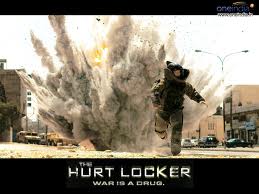

Jeremy Renner is the man!  I thought I would get that out there to start with, just to emphasise how much he brings to The Hurt Locker.  If they had cast somebody with less presence of character, the film would not have worked anywhere near as well, despite what other praise one could give it.  He plays Sgt. First Class William James, who steps in to lead a bomb disposal team in Iraq.  They have only a month left on their rotation, but the loss of their previous leader, Sgt. Thompson, has left them shaken, with a gap that seems hard to fill.  Sgt. James' methods and general view of his job seem, to Sgt. Sanborn and Specialist Eldridge, to be irresponsible and dangerous; this does little for Sanborne's requirement for order and discipline, and is especially threatening to the fragile Eldridge, who is already talking regularly with Colonel Cambridge, the group psychiatrist.

Kathryn Bigelow's intelligent movie, written by Mark Boal, charts the group's turbulent rotation and the psychology of the men who put their lives on the line in this way every day.  Not unlike Jarhead in its approach, it features relatively little violence for a war film, and few typical tropes of the genre. Even one scene involving a certain amount of macho-ism, in which they volunteer themselves to each others physical violence, is not actually about the violence, but about what is going on between the characters, the dynamic shifts occurring within the team, and how they view each other.  There are numerous parts that rely on subtext, or on the audience's engagement with the drama.
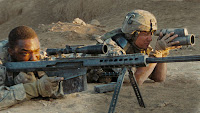
One central scene in particular has a lot going on with very little dialogue; this is the nature of the film in general, asking us to pay attention to the performances and story, rather than waiting for some action.  The film does not adhere to conventions very much; it is shot in a way that is suggestive of a documentary, with a feeling of not so much telling a story, but rather following a set of events.  That said, it is cinematic, with some scenes where performance and subtle, clever use of sound ratchet up the tension very well.  It is an unusual feeling, and it takes the first act of the film for us to get completely comfortable with the groove.  Once we are, however, it makes for a notably unique experience, and the fact we are focusing on a group of guys that other war films have never really looked at only adds to the freshness.

As for criticisms, there are people such as David Morse, Guy Pearce and Ralph Fiennes in this movie, but they border on "blink and you miss them" roles, which is a shame.  It could also be argued that when all is said and done, it does not feel like the film, for all its accolades, is really saying that much beyond its simple premise.  Contrary to the hyperbole surrounding it, it is not a film trying to set the world on fire, it does not have any political stance, it is not anti-war; it is simply an exciting look at the psychology of the men we follow.  The Hurt Locker has a great ending, in which the look on Renner's face, and the final shot as Bigelow brings in a track by the band Ministry to introduce the credits, perfectly underlines the point of Sgt. James' final monologue.

Not the astounding masterpiece some people might have had us think, and certainly not "the best war movie ever made", but very, very good.

4/5

 
Catch it if you like: Full Metal Jacket, Jarhead
  
ARLINGTON ROAD  (1999 - UK Certificate 15)

Jeff Bridges, Tim Robbins and Joan Cusack in a film which, had it been made a few years later, would be noted as what we now call "post-9/11", and in which Bridges is playing a role not dissimilar to his one in Blown Away with Tommy-Lee Jones.  A movie best enjoyed without knowing too much, but the long and short of it is that Bridges plays Michael Farady, who lost his wife to a botched CIA job and is now bringing up his son alone.  Upon driving home one day he rescues a young boy who has been badly injured; it turns out he is the son of the people across the road, Robbins and Cusack, and so begins a story of tense intrigue as Faraday grows more and more suspicious of his neighbours.

There are certainly things wrong with this movie, with some of it looking surprisingly "made for television", some of the supporting performances not coming off particularly well, and a couple of convenient coincidences to drive the story, but on the other hand it grips you from the opening scene, plays at some points almost like a horror, and has the courage of its convictions.  It features unsurprisingly good central performances, although at times they seem to be misdirected; we know how good these guys are, but we get the sense that perhaps director Mark Pellington wanted different performance options, and then wasn't sure how to pull it all together cohesively.  As a consequence, we have the odd scene where the performances seem oddly over-acted, although there is a valid argument that this is intentional, and required for the plot to work.  This, however, doesn't stop certain moments from feeling a bit awkward.

In any case, a film that has been a little forgotten, but if you like tense, domestic-type thrillers, this is one you should catch.

3.5/5


Catch it if you like:  Blown Away, Sleeping With the Enemy, Unlawful Entry 

Sunday, 27 January 2013

THIS WEEK: The Impossible

0 - No Redeeming Feature

1 - Poor

2 - Passable

3 - Good.  Rent it.

4 - Excellent!

5 - Must See!!


THE IMPOSSIBLE

What effectively appears to be a blockbuster disaster movie is perhaps one we would expect to come out of the Cameron or Spielberg canon, so when we see the name Juan Antonio Bayona, a director who is possibly unfamiliar to many who haven't seen The Orphanage, we are surprised and curious.  Upon closer inspection, The Impossible is in fact the incredible true account of a Spanish family's experience when the worst natural disaster Thailand has ever known hit in the form of a tsunami.  Many of us recall the disaster and its fallout, but this film takes us up close, following this one family's story, from their arrival, though their separation, to their departure.

Now there has been complaint from certain quarters that the film somehow does a disservice to the family by making them white Brits, rather than sticking to the reality that they are Spanish.  There is also claim that, by focusing on this one fortunate family's survival, the movie arrogantly disregards the experiences of those indigenous to the country, and those whose experiences were not so fortunate.  I find the prior accusation petty, and the latter ludicrous.  In casting big names Naomi Watts and Ewan McGregor in the lead roles, they simply ensure that the budget necessary for the production is more likely to be granted, and covered; the story of the family is still honoured well. The idea that somehow we ignore the plight of anybody else is just silly; certain moments in the movie, and in particular the beautifully conceived final scene, touch very well on the fact that many were not so lucky.  The title of the film itself ties in with Bayona's intent to illustrate just how rare the sort of good fortune it depicts was, and the family are shown to clearly understand this.  I am flabbergasted people are reading it any other way, to be honest.
The first ten minutes of this movie are filled with a tension; the fact we know what comes next makes the setup of Maria and Henry's great relationship with their boys, Lucas, Thomas and Simon somehow more distressing.  The next forty minutes are truly a technical miracle; never before have I been in a cinema feeling quite so overwhelmed by the depiction of a natural disaster.  Bayona uses incredible miniature sets, real water, terrifying use of sound, and superb in-camera make-up to stunning effect, forcing us to endure the entire tsunami as mother and son do.  We follow Maria and Lucas' events for about an hour before cutting over to Henry, Thomas and Simon.  I will say that there is, for me, something lacking in the second act of the film, but this is possibly because the first has blown you away to such an extent, the devastated quietness of what follows feels naturally muted.

This said, the performances carry through very well; McGregor is heartbreaking, and particular note has to be given to all the boys, who we adore pretty much on the spot.  I would also suggest keeping an eye open for Tom Holland, who plays Lucas; his arc and the maturity of his performance feels so wonderfully natural, it is a struggle to believe his only experience has been as Billy Elliott on stage, and voicing a character in 2010's Arrietty.  Naomi Watts has been nominated for a Best Actress Oscar, and whilst I suspect she will not win, I can say I have not seen her giving such a physical and emotionally draining performance, and that if you only see her in this and Eastern Promises, you might be forgiven for believing she is English.

This film does drain you; by the time you leave the movie, you do feel a little washed out, and thankful that in the end this is a story of human triumph over adversity and a celebration of spirit, rather than the dour tale it could have threatened to be.  Despite a second act lacking the kinetic force of the first, and the fact that Watts and Holland are really the more compelling characters and performances, and despite some moments where the gorgeous score does seem to teeter on being too much, overall this is a recommended experience.  I have no idea why it is not nominated for production design and sound editing, because it should wipe the floor in those categories.

4/5


At cinemas now.

Catch it if you like:  Natural disaster movies, or intense, emotional drama.