Search This Blog

Sunday, 27 January 2013

THIS WEEK: The Impossible

0 - No Redeeming Feature

1 - Poor

2 - Passable

3 - Good.  Rent it.

4 - Excellent!

5 - Must See!!


THE IMPOSSIBLE

What effectively appears to be a blockbuster disaster movie is perhaps one we would expect to come out of the Cameron or Spielberg canon, so when we see the name Juan Antonio Bayona, a director who is possibly unfamiliar to many who haven't seen The Orphanage, we are surprised and curious.  Upon closer inspection, The Impossible is in fact the incredible true account of a Spanish family's experience when the worst natural disaster Thailand has ever known hit in the form of a tsunami.  Many of us recall the disaster and its fallout, but this film takes us up close, following this one family's story, from their arrival, though their separation, to their departure.

Now there has been complaint from certain quarters that the film somehow does a disservice to the family by making them white Brits, rather than sticking to the reality that they are Spanish.  There is also claim that, by focusing on this one fortunate family's survival, the movie arrogantly disregards the experiences of those indigenous to the country, and those whose experiences were not so fortunate.  I find the prior accusation petty, and the latter ludicrous.  In casting big names Naomi Watts and Ewan McGregor in the lead roles, they simply ensure that the budget necessary for the production is more likely to be granted, and covered; the story of the family is still honoured well. The idea that somehow we ignore the plight of anybody else is just silly; certain moments in the movie, and in particular the beautifully conceived final scene, touch very well on the fact that many were not so lucky.  The title of the film itself ties in with Bayona's intent to illustrate just how rare the sort of good fortune it depicts was, and the family are shown to clearly understand this.  I am flabbergasted people are reading it any other way, to be honest.
The first ten minutes of this movie are filled with a tension; the fact we know what comes next makes the setup of Maria and Henry's great relationship with their boys, Lucas, Thomas and Simon somehow more distressing.  The next forty minutes are truly a technical miracle; never before have I been in a cinema feeling quite so overwhelmed by the depiction of a natural disaster.  Bayona uses incredible miniature sets, real water, terrifying use of sound, and superb in-camera make-up to stunning effect, forcing us to endure the entire tsunami as mother and son do.  We follow Maria and Lucas' events for about an hour before cutting over to Henry, Thomas and Simon.  I will say that there is, for me, something lacking in the second act of the film, but this is possibly because the first has blown you away to such an extent, the devastated quietness of what follows feels naturally muted.

This said, the performances carry through very well; McGregor is heartbreaking, and particular note has to be given to all the boys, who we adore pretty much on the spot.  I would also suggest keeping an eye open for Tom Holland, who plays Lucas; his arc and the maturity of his performance feels so wonderfully natural, it is a struggle to believe his only experience has been as Billy Elliott on stage, and voicing a character in 2010's Arrietty.  Naomi Watts has been nominated for a Best Actress Oscar, and whilst I suspect she will not win, I can say I have not seen her giving such a physical and emotionally draining performance, and that if you only see her in this and Eastern Promises, you might be forgiven for believing she is English.

This film does drain you; by the time you leave the movie, you do feel a little washed out, and thankful that in the end this is a story of human triumph over adversity and a celebration of spirit, rather than the dour tale it could have threatened to be.  Despite a second act lacking the kinetic force of the first, and the fact that Watts and Holland are really the more compelling characters and performances, and despite some moments where the gorgeous score does seem to teeter on being too much, overall this is a recommended experience.  I have no idea why it is not nominated for production design and sound editing, because it should wipe the floor in those categories.

4/5


At cinemas now.

Catch it if you like:  Natural disaster movies, or intense, emotional drama.

Saturday, 19 January 2013

THIS WEEK: Les Miserables/Hatchet/The Kid With a Bike/Tiny Furniture

0 - No Redeeming Feature

1 - Poor

2 - Passable

3 - Good.  Rent it.

4 - Excellent!

5 - Must See!!


Les Miserables

Les Miserables is based on the novel by Victor Hugo, which became one of the most beloved stage shows of the last century.  It is a story that starts with the simple idea of a man, Jean Valjean, who stole a loaf of bread out of desperation; his release, his breaking parole, and a moment of forgiveness sets in motion his own redemption, and the ongoing search for him by Inspector Javert.  From here the story goes on to cover a vast amount of time and culminates in the 19th Century French uprising, whilst dealing with issues of class, love, forgiveness and responsibility.  I heard it described rather well as, "a big, musical, French revolution-set version of Pay It Forward", which is not, at times, too far off the mark.

Tom Hooper comes off the back of his success with The King's Speech, and with this sets about upping his own game; Les Miserables is an all-round bigger, more daring artistic undertaking.  It seems that Hooper recognizes the stirring nature of the stage show, and that to adapt it for the screen there are two tricks necessary to play: don't fix what is not broken, and go balls-out to make it as big and dramatic as possible!  It is obvious from the opening scene, however, that he is keen to do everything with this musical that cannot be done on stage, the camera giving us an epic scope, swooping in, out and through incredible sets and landscapes.  It also gives us close-up, intimate interactions with actors as they work.  I have seen it said that this is, at times, misjudged or distracting, but I can honestly say I did not find it to be either, although I did note his refusal to play that much in mid-shot, almost, it seems, on principle.  This did not bother me, but I can understand it being frustrating to some.

Hugh Jackman is excellent in the role of Jean Valjeant; this is the bravest and best I have seen him since The Fountain.  Russell Crowe is the strangest bit of casting imaginable for a musical such as this, and yet the film contends with it rather well.  There has been some talk of Crowe being not as mean as the stage version of Javert, but it is in fact his presentation of a more complex man, struggling within himself, that makes his performance so vivid.  When you can get an audience caring this much for who is ostensibly a rather bland villain, you have done something right, and I certainly found myself caring for him as a human being rather than viewing him as simply, the bad guy.  In spite of being a bit out of his depth technically, in terms of singing voice, it is his finding of this character that somehow makes it work, and he actually delivers the song Stars with a striking beauty, a beauty which makes it one of the best scenes in the movie, and which highlights all the more why he works.  Hearing the audio is not enough; you actually have to see it, but when you do, it makes sense.  Bringing some light relief to what is otherwise a pretty heavy and dark affair are the very well cast Sacha Baron Cohen and Helena Bonham Carter, playing a couple of criminal inn-keepers, and looking like they've been dragged directly off the set of a not-yet-complete Tim Burton picture.

Anne Hathaway plays the disgraced Fantine, and she delivers from her first frame to her last, proving that she is certainly much more than just the pretty face.  When the character is at her lowest, with all hope snuffed out, she creates a new Somewhere Over The Rainbow with a barn-storming I Dreamed a Dream, a silver screen moment that is immediately classic, and which will be recalled for a long time to come as the scene in which a new bar was set for this classic song.  I very much doubt anybody will come close to affecting me with this number the way Hathaway does here; it is genuinely impossible to overstate just how powerful she is, as she hits nearly every negative emotional beat, clearly meaning every single word and tearing your heart out.  The trailer used a brief moment of her performance, but if that is all you have seen, you are not prepared, trust me.
Eddie Redmayne gives a surprisingly good turn as Marius, but it is his solo that renders us almost inconsolable.  Much like Hathaway, he throws himself into the performances with such an unexpected ferocity, you cannot fight its power.  These moments are ones in which maintaining a stiff upper lip becomes impossible, and if the lights were turned up, you would see everyone is in the same boat - falling apart becomes an utterly shameless act.  It is in these moments, also, that we forgive the odd wobbly note elsewhere, as we witness the benefit of actors being able to fully perform, rather than simply lip-synch a perfectly recorded track.  With the cast able to act their way through a scene, creating character and behaving in each moment as though they were delivering spoken dialogue, we experience the full force of the performance, warts and all.  The freedom to improvise with the live piano in their earpieces means the delivery is not always as precise as we might expect, but the payoff is the passion of it all; in this way it a bit like good jazz!

Intrinsic to the film because of the story is a sense of what I call "bittiness", one set of characters or set piece leaping to the next set of characters or set piece, which does jar at times, especially in the second half.  Why Inspector Javert is quite so intent on finding the "dangerous man" Valjean, as to search for years, is something never really understood, and it makes for a frustrating sort of convenience that they are continually running into each other for the sake of driving the story forward.  It will take some a little while to settle into the groove and feel of the film; something about everyone singing everything is a tad alienating, but we do reach a point where it settles in nicely.  This said, a few scenes never get around feeling a bit awkward in their staging, which was an unfortunate, but only occasional issue for me.  I must also admit that, where most of the music and songs are powerful, dramatic, raucous, exciting, and in one case even amusing, I could not help but notice some moments that don't work as well, with at least one song that really, for me, couldn't be over soon enough.  I do, of course, understand this may be a case of taste.

The thing about this movie is, even at its weakest moments, there is an overarching feeling that everyone loves what they are there for, and that they are giving heart and soul to make it as staggering as they can; they intend to make you experience something worth every penny paid for admission.  The more full-on, risky and daring it is, the more we can't help but think, "Like it or not, this is what cinema is all about!"  In spite of the individual issues we may pick out, this behemoth production rocks you at a core level; it is rough around the edges, but it makes virtues of most of its flaws.  Technically not the five-star show people know, but its bravery, gusto, and full-on determination to stir your spirits wipe out the negatives and power it through as a film, nay an experience, I found myself enjoying as though it were a masterpiece.  Do not be surprised if some people cheer at the end, or you find yourself, at the final ensemble scene with goosebumps, wanting to start your own revolution. 

4/5


At cinemas now.

Catch it if you like: The King's Speech, or the prospect of a risky musical spectacle with balls!

HATCHET

Adam Green would go on to write and direct a film called Frozen, which I recommend, but before that he made this cult classic send up of the B-Movie horror.  Two guys find themselves stuck in the middle of nowhere with a group of holiday makers, being hunted by a ghost of the disfigured character named Victor Crowley, who, stuck with the rage of the night he was burned to death, is out to kill everyone who crosses his path.  Hatchet tells of the group's gradual demise in typical slasher fashion.

Opening with a sequence starring the legend Robert Englund (Freddy), following it up with a credit sequence set to Marilyn Manson's This Is The New Shit, and featuring a cameo by the great Tony Todd (Candyman), it is quite clear what Green's intentions with the film are; this is low budget, ridiculous, well scripted nonsense, full to the brim with bad cliche, and it is one of the most fun splatter-fests I've seen for a while.  It is undeniably bad, but what elevates it is the sense that Green is so up on the genre, and so in love with the tropes, that he has set out to have some fun with it, hence the laugh out loud dialogue and the film's overload of self-aware irony.  Make no mistake, this is no Wes Craven, it is more Romero with a knowing twist of self-ridicule.  Granted, it does lose steam in its final third, but if you know what you're watching, and are not looking for something trying to be good, you could have a great time with this.  I know I did.

3/5


Catch it if you like:  The Cabin In The Woods, The Evil Dead, Scream, and B-movie schlock horror.

THE KID WITH A BIKE

Very little to say about this film, not because it's not good, but because it defies that much of a review by its nature.  A troubled young boy clings tirelessly to the idea that he can be with his father and along the way discovers what real love and a parent should be.  Somehow it all revolves around his bike.  Typical of French cinema really, it is not without its charm and it whizzes by nicely.  Cecile De France, who some may know as the central character in the flawed but fascinating Switchblade Romance, gives a typically fine performance as a woman who takes on responsibility for the boy Cyril, inexplicable as it may be, and Thomas Doret is very good as the titular kid himself.  I cannot say I did not enjoy it, but there is a sense that there was little concern for fleshing that much out at the writing stage, and it never really resolves that.  The film also comes to a swift close which, whilst not a bad place for the story to find its end, does leave it feeling somehow unfinished.  All-in-all a humble and charming slice of French drama, but nothing to write home about.

3/5


TINY FURNITURE 

Lena Dunham is a writer with a future; writing, directing and starring in a film is a trick only occasionally pulled off well by the big boys not preceded by their ego, but watching Tiny Furniture, you are aware she has some chops.  A quick look at her IMDB page confirms the suspicion that she has had, and continues to gain, experience in many artistic fields, from the writing to editing to acting and now, directing.  Here she plays Aura, a college graduate who returns to live with her mother and sister while she works out what to do with herself.  This entails meeting a minor internet star and letting him stay at their home while her family are away, becoming a day hostess for a restaurant that never seems to have any custom, and unwittingly burning every bridge that could be important to her.

An off-beat drama featuring her very own mother and sister, pretty much playing themselves, it turns out, this feels like a Woody Allen piece.  If this is evidence to go by, Dunham has some way to go before she makes a truly compelling film, however, given its shoestring budget and low-key nature, it is not without some charm and good ideas.  It is also no doubt quite reflective of her own family, her mother actually having an artistic career not unlike the one presented in the film which, given some of the scenes in the film, make me wonder just how biographical the whole thing is.  Some of the drama works, some of the humour works, and the final scene is a thoughtful footnote.  Tiny Furniture, as the title suggests, is about small things, which turn out to be quite big things.  Not wholly successful, but worth a look.

2.5 / 5


Catch it if you like: Ghost World and the like.

Saturday, 12 January 2013

THIS WEEK: Silver Linings Playbook/Shame/Coriolanus

0 - No Redeeming Feature

1 - Poor

2 - Passable

3 - Good.  Rent it.

4 - Full Price

5 - Must See!


SILVER LININGS PLAYBOOK

It must be said that despite its plaudits, The Fighter is not a film that was particularly impressive to me, and David O. Russell is not a director I can safely rely on for a guaranteed great film experience.  Likewise for Bradley Cooper, who has proven himself as a perfectly fine leading man previously, but is most notable for his role in films I don't rate.  Add to this the fact that one of the greatest screen actors of all time, Robert De Niro, has made similar-looking film choices in recent years that were questionable, and that the marketing campaign for Silver Linings Playbook seemed to have it setup as a rather forgettable rom-com, set awkwardly around the subject of mental illness, and you might understand my concern going in.  I am therefore happy to say that not only was I pleasantly surprised, but that I actually put it straight in as one of my favourite films of 2012!

The film centres around Pat, who suffers a bipolar disorder and who has, due to an unfortunate incident involving his wife and her lover, recently spent eight months rehabilitating at a facility.  He is brought home to live with his parents while he gets back on his feet, but is convinced he can make contact with his wife by means of a letter and that everything will be back to how it was, despite the fact she has had a restraining order taken out against him.. Exactly as you might expect from the synopsis, it is very much a story which, in the wrong hands, could have become a debacle of bad taste; as it is, Russell marshals it all rather well and creates a solid, engaging drama.

Now let's not get carried away, it is not a masterpiece; some notable technical errors, including at least one scene that bordered on misguided and farcical, though admittedly well staged, do hold it back.  It is also, in the end, little more than an extremely off-beat romance; even in dealing with mental illness, and addressing issues like the ill-judgement of people affected, it still has nowhere near the same important resonance as, say, One Flew Over The Cuckoo's Nest.  Beyond this, however, there is a lot to be admired, and it starts with the grace with which it handles the subject.  This seems to stem from the fact that the author has great respect for the characters, and that Russell apparently has a personal relationship with the subject through his family.  I must say it shows; every character has some relationship with mental disorder, and though there are moments of lightness, the humorous edge of the film grows organically from the story, in the way it would in reality, rather than being forced.  We are never made to feel we are complicit in pointing and laughing; on the contrary, I found every single character, major or minor, to be very well drawn and someone I felt I could believe in and in whom I could invest emotionally.

It is also a film that seems determined to defy quite a lot of convention; just as you suspect certain plot points or moments are about to go one way, some might say the Hollywood way, it in fact goes somewhere else, on one hand surprising you, and on another carving a deeper sense of empathy and realism.  To cite examples, watch out for a scene in which Pat gets into a real physical fight with his father, or his discussions with his therapist; moments like these, due to their sense of realism, engage you all the more with the characters, and make them so much more than mildly humorous cliches.  It does, of course, go into Hollywood land eventually, but by this point, such has been the good judgement of the movie in nearly every way, you find yourself enjoying it rather than being cynical.  De Niro's reaction to the "big moment" in the finale, as well as the moment itself, is so wonderfully, awkwardly, and realistically amusing, it is one of a few genuine laugh-out-loud moments, and the scene also features possibly my favourite line in the movie, by an extra, no less!

Much has been said for the performances, and rightly so.  From the smaller roles, such as the one filled by Chris Tucker, to the major, I don't think I can find a weak link; if anything, it is their drawing I would like to have seen more of, rather than better performances.  Jennifer Lawrence is exactly the effortless performer I have come to expect, and I only take this opportunity to recommend to everybody a film called Winter's Bone which, whilst not perfect, features a quiet, intense, star-making performance from a younger Lawrence.  When Bradley Cooper is given good material, he is a terrific lead, and I just wonder to what degree he sought advice from his on-screen father De Niro who, forty years earlier, may have easily walked away with an Oscar for a performance Cooper is here required to give.  Speaking of De Niro, it is good to see his chops not lost and that he still owns his time on screen; it is fair to say I have not seen him this good for a while, and it is a joy to watch him back on form.  Best Supporting Actor nomination, ahoy!

For me, one of the big surprises of 2012, and in the strangest way, the best feel-good film I have seen for some time, Silver Linings Playbook is an engaging, well-crafted piece of storytelling.  Some of its ideas are ultimately a bit above its station, but it is still a wonderful two hours.

At cinemas now

4/5


Catch it if you like: Good Will Hunting, One Flew Over The Cuckoo's Nest. 

SHAME 

I was aware of Steve McQueen as an artist, whose work I even recall studying at GCSE here in the UK, but it was his debut feature Hunger that confirmed him as a serious film maker.  Hunger also confirmed the suspicion I had roused by the movie Eden Lake, that Michael Fassbender is a screen force who demands some real attention.  Here in McQueen's second feature he plays Brandon, a thirty-something living on his own in New York, whose professional life remains steady, while his personal one is absolutely driven by a need for sexual gratification.  Whether it be through pornography, random women like the one at a bar his boss wants to take home, prostitutes, or simply regular trips to the bathroom to have a friendly get-together with his hand, he is in need of release through sex.  To understand a film is about such a topic, two things come to mind: it sounds funny, and even if it is not, it is undoubtedly going to be a piece of erotica not far removed from pornography.  In fact Shame is neither funny or erotic.  It is explicit, but that is to be expected.  What it is actually about is far more interesting; a sincere examination of a lonely, lost soul in a vast, faceless city, and the need, and importantly the lack of desire, to find something more, to feel connected, to feel human.  This need seems highlighted when Brandon's sister arrives in the form of the terrific Carey Mulligan, their fraught relationship and her attempt to connect with him managing to pull his life apart and force his self-reflection.

This is a movie I did not get to writing about straight away, as I felt the need to let it settle before feeling I knew what I wanted to say about it.  With that being done, here it is.  There is a lot to be admired about this film, and here is where the problems also begin; it is a film to be admired in its bits and pieces, but not embraced as a whole.  When it gets dynamic and dramatically gripping, it is primarily because Fassbender and Mulligan do outstanding work with what they are given; they have a terrific chemistry as siblings who are both disturbed in their own way, and particularly in scenes where a disturbed past is hinted at, they perform expertly.  At no point are we told anything, and in the end it is down to us to consider their potentially unsavory history.  This has two functions: the absolute lack of exposition between characters who already know everything about one another keeps it realistic, and the sense that we never really get to know them properly keeps them devoid of something vital, preventing them from being utterly human, which is of course the point.  It must be said, as superb as Mulligan is, she is not given a great deal to do overall, and so it becomes very much Fassbender's film in terms of performance.  Once you get around the fact that you see a reasonable amount of his penis in this movie, you can easily see why many eyes were on him at the Oscars last year; Brandon is a difficult, quiet, damaged and complicated man to play, and the fact the majority of our understanding comes only from the actor's expressions and behaviour is impressive; that we actually see a character development and arc in Brandon is testament to Fassbender's talent.  As was shown in McQueen's debut, he clearly works well with the man.
  
The film has a stunning score, which is arguably the best thing about it.  Sounding like Hans Zimmer half asleep, its haunting nature captures perfectly the sad tone of disconnection, loneliness, and ultimately the apparent futility of the effort to change the situation.
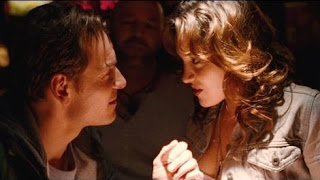
McQueen has an undeniable eye for excellent composition, which is no surprise; as an artist he has a keen understanding of how powerful an image can be, how one tableau can speak a hundred words, and that is very obvious throughout.  The whole thing is shot with they eye of a man who is first and foremost an artist, so there is no denying the film's urban beauty.  Such is his insistence, however, on getting across the points through visuals and long, protracted scenes in which so much is unsaid, or so much is about the internal, and which sometimes border on overdone, that I found myself often realizing I might do just as well to read a memoir of this man, rather than watch it be played out.  It looks and feels like a book.  In terms of the story unfolding, it does so in quite a stagy way at times, and this highlights an issue McQueen has not really overcome with either film, which is his inability to drive forward with a narrative.  His desire to put individual scenes together and create moments is a priority, and so the drive of the film seems laboured.  This said, staging of said moments is impressive, much of the film having an almost Kubrick feel of precision, keeping us intentionally somewhat removed from the characters, which, given the subject matter, brings about an obvious comparison to Eyes Wide Shut.  This is true for all scenes barring one towards the end, which seems decidedly unrealistic; set against the impressive realism of the rest of the film, this was strange and took me out of it. 

I consider Shame rather flawed, and can't say I liked it, yet I found it compelling and moving; in this way it is a strange movie to pass a clear verdict on.  McQueen is very confident in his transition to film; his work thus far is admirable and does have a power, but in the end Shame equals, for me, less than the sum of its parts.  To each their own, of course, but I would suggest you can see some similar issues tackled, with perhaps more narrative flow, and far less handsomely, in work like Intimacy with Mark Rylance and Kerry Fox, and Open Your Eyes with Clive Owen and Alan Rickman.

On DVD/Blu-Ray now.

3/5


Catch it if you like: Eyes Wide Shut, Hunger, Intimacy, Open Your Eyes.

CORIOLANUS

Ralph Feinnes takes one of William Shakespeare's lesser known, longer plays, and adapts it for the big screen.  Those familiar with the play will argue it has been too cut down, and some purists will decry any modern adaption, almost on principle, it seems.  Just as with Romeo and Juliet, though, we see the beauty of Shakespeare's poetry pushed to the front, delivered with much power by a cast featuring some surprising players.

Most notable by the fact he should seem out of place is Gerard Butler, who actually fits right in as Aufidius.  He is an interesting character, he respects his enemy, and wants to overthrow him; both facets have to be made clear and this is a dramatic task Butler rises to rather well.  Also giving a surprisingly exciting turn is James Nesbitt, as an angered Tribune.  Alongside them is a host of far more immediately comfortable-looking actors, including Jessica Chastain, Brian Cox, and Vanessa Redgrave, who almost steals the piece as Volumnia.  Shakespeare did love his strong females, and she is no exception.

Unlike Baz Luhrmann's bombastic take on the star-crossed lovers, Coriolanus is treated with a far sterner hand; you can almost feel Feinnes scowling from behind, as well as in front of, the camera!  What a performance he gives, though, intense and frightening on one hand, spitting the vitriolic monologues with relish, yet just as convincing when playing sheepish and pathetic under his mother's authority.  If you like to hear this stuff acted out, this is definitely a treat of a movie.  The reason for the firm handling is, of course, that this play has no sense of frivolity or fun about it; this is an all round meaner piece about social upheaval, prompted by a Roman warrior who is too proud of his position to care about being a voice for the common man.  The commoners revolt and banish him from Rome, we see his loyalties easily corrupted by his pride, and we watch him turn to his life-long enemy in order that he may attack his people.  The tension heightens, and we cannot help but understand Feinnes' choice to make it; one cannot fail to see its relevance today.  The inclusion of familiar BBC faces playing their part as news readers and talking heads in the piece is a smart move, really bringing the drama into modern day and making it feel all the more familiar and relevant.

With the good comes some of the bad, of course; Feinnes' lack of experience in handling action sequences shows, the city of Rome appears to consist of very few people, which does not help give weight to the idea that there is an uprising, and there is a sense of the film petering out rather than ending with the real dramatic bang one might expect.  The power of the writing, however, an exciting use of music, and the principal performances make it a compelling adaption of a play that illustrates how relevant the Bard remains.


On DVD/Blu-Ray now.

3.5 / 5


Catch it if you like:  Romeo and Juliet, solid Shakespeare adaptions.

Sunday, 6 January 2013

THIS WEEK: Pitch Perfect/Quartet/Even The Rain/The Prey (Le Proie)

0 - No Redeeming Feature
1 - Poor
2 - Passable
3 - Good.  Rent it.
4 - Full Price
5 - Must See!

The new year brings with it a host of promising films and here follows my take on one of the first releases of 2013, along with no less than three previously unwatched movies.  Yes, I did well this week.

PITCH PERFECT

Anna Kendrick is coming to prove her worth with her last few film choices; whether one likes the movies or not, she is undeniably a strong screen presence and an actress who, like Pattinson, appears to have the talent to get out from under the Twilight shadow in the long-run.  Here she plays Beca, a woman who joins Barden Universtiy with one goal, to become a DJ.  Upon arrival she is swiftly accosted in the shower by Aubrey, who hears her singing voice, and is almost ordered to join the all-girl singing group The Bellas.  The Bellas compete each year in the campus singing competition, and it is clear that this time they have more to overcome than just their male competition, The Treblemakers.

It featuring a lot of teens straight out of performing arts, musical set pieces, witty one-liners, and is directed by Jason Moore, responsible for episodes of Dawson's Creek and One Tree Hill, among others.  The Glee similarity is all too clear, and Moore's TV roots do show; given that, there is no denying the trepidation I felt walking in.  Much to my surprise, then, and I would by lying to say otherwise, I found myself entertained.  Yes, it is exactly what you would expect when you look at the poster, not much more or less, but it is raised above the average by the musical elements genuinely working well, the refreshing look at the girl group as human beings with different personalities, rather than as being simply 'mean girls', and a strong sense that Moore understands its intended audience.  This is perhaps best reflected by the choice to heavily reference The Breakfast Club in the story; many who watch Pitch Perfect may not have seen it, but could well be encouraged to go take a look, and understand the use of this coming-of-age classic as a reference point due to its influence.  It is not to say the two are at all in the same league, but it is to say the movie remains arguably the most iconic of the field Pitch Perfect is aiming to be included in.  The narrative and character development is fairly weak and there is no getting around the fact it is clearly at its best when being funny or breaking out the music action, but it is what it is and it does the job well.

Most people will recognise the standout element of the film, the thing most people will talk about, as Bridesmaids' Rebel Wilson as Fat Amy; she is intentionally given some of the best lines and she delivers superbly.  The film is worth watching for her!  Pitch Perfect will do exactly what we expect, be popular for a while, particularly with the crowd into this sort of movie, and then gradually be forgotten, but Wilson is a comedy gem of the future; she is here to stay!

At cinemas now.

3/5

 QUARTET
Dustin Hoffman directs what is otherwise a quintessentially British play-turned-film. A quartet of yesteryear's professional opera stars are asked to perform again at a gala, which will save the retirement home in which they now live. You might be forgiven for assuming this will end up being a stuffy piece, about a boring topic, which will hold only the interest of a select audience, but you would be wrong on all counts.

Quartet's winning stroke is the casting; I could not imagine a better line-up of four performances I would rather watch.  Not one of the principal cast drop the ball and I am hard pushed to choose any actor's performance over another; this is supported by the fact they are given such humorous, touching, and most importantly, real dialogue to deliver and honest emotion to play.  The situation that emerges and how it plays out all feels so natural, there is no avoiding being drawn in, entertained, and ultimately moved by it.

The film is no longer than it needs to be, rather dry with its humour, touching with its sentimentality, without over-egging it, and well observed in its detailing of the people you are watching.  You come to realise, fairly quickly, that what is important is not whether you enjoy the subject of the music, or whether you are of an age that you will naturally relate to the characters, but just that you understand the frame of reference through which the touching story of love and regrets plays out.  It is not a film to set the world on fire, and will likely be swiftly overshadowed, but it does what it does very well.  It is a touching, enjoyable movie for all, which will likely find its most loyal audience outside of the cinema, on a lazy Sunday afternoon.

At cinemas now

3.5 / 5

EVEN THE RAIN

An almost perfect drama, which beautifully balances the story of a film being made about exploitation of the New World with exploitation in the real world.  A film being made, about Columbus' discovery of the New World 500 years ago, enters turmoil as around the film makers the people of Bolivia enter into a volatile urban war over water.  In their efforts to complete what they consider an important movie no matter what, the question is whether the film makers are becoming a cog in the very machine their film decries?

It takes perhaps half an hour to settle into a groove, and with it being a foreign language movie, I might understand some people losing interest and switching offThis is a shame, as Even The Rain actually rewards patience; it becomes an extremely engaging drama about politics AND people; it is provocative, exciting, very well put together, and is easily among my top ten of 2010.  Telling a tremendous story and featuring a great screen presence in Luis Tosar as pragmatic producer Costa, this is a superb movie all should see.

Get it on DVD/Blu-Ray now.

4.5 / 5

Catch it if you like:  Che, Fair Game, The Hurt Locker, Lebanon.

THE PREY (LE PROIE)

Released in 2012 and totally overlooked, I won't say much about this except it is another typically impressive slice of French thriller cinema, looking like Hitchcock directing a Tarantino screenplay, if you can imagine such a thing.  Primarily a cat-and-mouse chase, it is a bit let down by its odd score, which does feel a bit Pink Panther at times, but it also features some terrific actions sequences, a wonderful central performance from Albert Dupontel, who cinephiles will be likely to recognise, and it is all underpinned by an exciting idea that feels like a Harlen Coben novel.  Worth checking out.

On DVD/Blu-Ray

3.5 / 5

Saturday, 29 December 2012

MY CHRISTMAS VIEWING

0 - No Redeeming Feature
1 - Poor
2 - Passable
3 - Good.  Rent it.
4 - Full Price
5 - Must See!

Well now, I trust everybody got fat, jolly, and had a good time over the Christmas holiday?  I trust you are all looking forward to a great new year; it can't be worse than 2012, surely?!  Anyhow, I write this new entry on my brand spanking new laptop, and so far it is very nice, although I must say I'm not keen on the Windows 8 start screen.  Anyone know how I can convert it so that the laptop starts up with the classic Vista or 7 feel, do feel free to let me know.  Anyhow, as you might expect, aside from visiting friends, entertaining family, giving and receiving gifts and eating and drinking a lot, some of the holiday was spent on the sofa, and once in the cinema, in front of Christmas movies.  Here is a rundown of films seen this week, which I have not yet mentioned on this blog.

RISE OF THE GUARDIANS 

Chris Pine lends a good vocal to Jack Frost, who for a long, long time, has been unseen by children and whilst having a great deal of fun, remains at a loss as to his purpose.  It is when an evil spirit named Pitch Black threatens to wipe out all hope and belief in the Guardians, North, Pitch, Sandy, Tooth and Bunny (no prizes for guessing who is who) that Jack is summoned to help fight for the wonder and joy of children's belief.

It is a perfectly good idea, visually impressive, features reasonable performances from Hugh Jackman and Alec Baldwin, along with a notably fun one from Jude Law, and I do not doubt that it will be a kids' seasonal favourite.  Personally, I would have liked a bit more development on the idea of darkness being part of growing up, rather than the focus on it as an enemy to be banished; for a children's movie it seemed the character of Pitch lacked any learning curve about his role, and that disappointed me.  That said, it is what it is and for its audience it works perfectly well; not a classic, but I had a good time with it.

Still at cinemas.

3.5 / 5

Catch it if you like:  Seasonal animated features

DIE HARD

Yes it is a Christmas movie, and yes it is a classic.  In fact, do I need to talk about it?  John McClaine kick ass, rocking the vest look, in the best of the lot; it is the only Die Hard with pretty much zero flaws.  A fast paced riot of a movie, full of witty dialogue, great characters, and lashings of humour and excitement.  If you haven't watched it at Christmas time, shame on you!

Pick it up as part of the box set now.

5/5

Catch it if you like:  Good action films!

IT'S A WONDERFUL LIFE
Upon first inspection it is perhaps easy to understand why when first released, Frank Capra's Christmas movie, inspired by a simple seasonal card, was not well received.  It is a movie that opens with a fantastical scene of a star, later revealed to be an angel, talking to a faceless God, the voice-over stilted in sweet humour, and immediately suggesting the film is going to be one that is too saccharine a pill to swallow.  The thing is, beyond that, It's A Wonderful Life is the ultimate exercise in feel-good cinema, its virtue as such much referenced in TV and other films.

The film presents George Bailey, played by James Stewart, who would go on to refer to it as his own career favourite; Bailey stifles his lifelong dreams of traveling and discovery in order to save and run his father's Building And Loan Association.  It has long been responsible for the affordable housing in his hometown Bedford Falls, and he cannot see it lost to the scoundrel of the piece Henry F. Potter, who is a major shareholder in the Building And Loan and the only man residents could otherwise turn to.  A run at the bank leaves the Building And Loan on the brink of financial ruin, George's Uncle Billy misplaces $8000, and in an act of desperation George attempts suicide, at which time he is saved by the angel Clarence.  Understandably confused, he wishes he had never been born, and so his wish is granted.

If the plot seems familiar even though you have not seen It's A Wonderful Life, it is probably because you saw the idea loosely re-worked in the Nicolas Cage film The Family Man.  For all its up to date technique, its colour, modern setting, etc, this version could not capture what made the original.  So, what did make the original? What may surprise people is how Capra clearly believed in the notion that you have to suffer the low to get the high.  The second act of the movie gets really quite dark, with Bailey seeing what the world would be like without his birth, coming to understand just how important a person is to everybody else's existence, and bringing him to a full appreciation of his worth as a husband, father and friend.  The finale is obviously that classic scene that we all know, even if we do not realise it, with his daughter's famous, "Every time a bell rings, an angel gets its wings", and despite how much you might think the whole thing sounds cheesy, silly, saccharine and sentimental, the power of the film is to bring a genuine tear of pure enjoyment to your eye regardless; for a while you are full of the joy of life and completely happy, no matter what.

A lot of the film's success comes down to how believable James Stewart makes the plight; his performance is another illustration of why he is one of my all time favourite actors.  He shows how well he can hit any emotional beat, not to mention handle rather complex moments where a lot is being unsaid.  For just one example, check out the scene in which he wanders into Mary's mother's home and takes Sam's phone call - incredible!  For any flaws you may find with it, its colourful characters, its tremendous performances, humour, heartbreaking moments, perfectly pitched highs and lows, and its' unabashed final sequence make this an inexplicably perfect film.  No wonder it remains at the top spot of many people's favourite Christmas films, and so it should!  Oh, and see it in the original black and white, not the new, fancy colour, which is clever, but ugly.

Pick it up in stores or online.

5/5

Catch it if you like:  Good seasonal movies, as it may well be the best of the lot.

LOVE ACTUALLY
Okay, let's get this straight, at any other time of year the cynical critic in me would poo-poo this movie, to a certain degree, at least.  It is all over the place and even by Curtis' standards, it is no masterpiece.  Yet, at Christmas, it is perfect.  Every thread, every performance, from the completely stupid to the utterly believable and heartbreaking, balance out to make a strangely enjoyable film.  A mishmash of true to life love stories and utterly laugh out loud moments, strung together by coincidence and people who are minor characters in others' lives, this always leaves me feeling warm inside.

Buy it anywhere.

4/5

Catch if if you like:  To feel good.

THE POLAR EXPRESS

Robert Zemickis works with Tom Hanks again to bring the wonder of Christmas home.  The story of a young boy doubting the existence of Santa does not preach or treat the subject in any sort of patronizing way one might expect.  Instead what we get is a visually stunning Christmas film about the wonder and joy of the idea of Santa, while it lasts, and the magic of the time of year.  On repeat viewing, I did find myself realizing just how much like a dream the films plays out, and how it may have been improved with a bit more narrative meat, but when you're sat in on a cold Christmas eve, drinking hot chocolate, there is nothing you'd rather be watching.

Buy it anywhere.

4/5

Catch it if you like:  Seasonal movies.

Saturday, 22 December 2012

THIS WEEK: Life Of Pi

0 - No Redeeming Feature
1 - Poor
2 - Passable
3 - Good.  Rent it.
4 - Full Price
5 - Must See!

LIFE OF PI

 Pi Patel, played for the most part by Suraj Sharma with a confidence defying his absolute inexperience in front of the camera, and surely qualifying him for a Best Actor nod at the Oscars, is thrust into an adventure of survival at sea. The ship carrying his family and their zoo hits bad waters, inexplicably sinks, and from there he must learn how to share the confined space of a lifeboat with his only companion, the tiger Richard Parker.

Like 'Cast Away', due to its idea a great deal of the film is without speech, save for Pi's one way conversations with the animal and the occasional narration by adult Pi, played by a spectacular Irrfan Khan, who is telling his tale to an author, one who is after a great story that will "make you believe in God". Also much like another of this year's spectaculars, 'The Hobbit', the front end of the movie is loaded with a lot of setup, which those who only saw the trailer may find surprisingly hefty. Unlike 'The Hobbit', however, this front end engages you fast and it is not long before you are enjoying the development of Pi as a character, the amusing finding of his faith, his love, and his place in the family. Some genuinely hearty and smart humour can be found in this first act, also. The brilliance is that whilst it is not in any rush to get where we all know it is headed, at no point is there any wish for Lee to push it along faster; there is some understanding intrinsic to the direction that this is all important and not to be overlooked, which even those who have not read the hugely popular book pick up on. To add to this, it must be said that the length and pacing of this movie are outstanding; you would not want any more or less time spent basking in the warmth of the love and care that clearly went into putting every single gorgeous frame on the screen.
The second act is where we really see the film kick into gear and start rolling out what is stunning audiences and critics alike. From the greatest CGI animal I think I have seen on the silver screen, to the overwhelmingly beautiful photography, effects, and perhaps not the first, but certainly the best use of 3D technology to enhance the engagement with a story, 'Life Of Pi' sweeps the floor visually with anything previously held up as a bar setter.  Nothing against those previous movies, but it really does.

 All of this is obviously nothing without everything else being in place, and thankfully Ang Lee knows that the heart of his film is not how pretty it is, but the story by Yann Martel and the themes with which it deals. So what is 'Life Of Pi' about? The wonderful thing about this piece is that this answer could be different for you than it was for me. It is about a boy surviving at sea with a tiger. It is about the nature of life, death and loss. It is about the balance of fear and respect. It is about love and hope. It is about humanity and compassion. It is about religion and faith, faith not just in a higher power, but in anything in the world. It is about all of these things at once, but what I most took away from this film is how it is about the nature of nature itself. Yes, it sounds heavy and preachy, doesn't it? The truth is Lee gets the balance absolutely spot on; you take from the movie what you want and at no point does it preach at you about anything. It does not matter how you walk in, an atheist, a Hindu, a Christian, but if you are a human being with anything close to an open heart and mind, you might just walk out feeling like a better person!  Released for the festive season, it is an oddly uplifting film that entertains on one hand, and on the other is positively philosophical about our place in nature, our treatment of her, and of one another. Not often would I say that a film might just change your life, but as the film reached its finale, with both Sharma and Khan absolutely owning their respective final scenes, I realised I had been inescapably moved to tears more than once, had consciously assessed how I think about certain things, and that yes, this film just might change you for the better.  Is the preceding challenge to make a character believe in God achieved? That would be telling, but more importantly, it does not matter; in a rather smart bit of writing and beautiful execution of a twist in the tale, the film underlines that this is not really the point, and indeed never should be.

Ang Lee is a man who directs with a heart full of compassion, and a head full to its brim with an understanding of cinema's sheer power to entertain, engage and challenge, sometimes all at once. A look at his previous work is evidence enough of this; sure, not everything is a hit, but never could his passion for cinema, bravery and humanity, be more on show than with 'Life Of Pi'.  He has done what was said to be impossible, taken a book that should never have translated to cinema, and not only made a successful film, but made the all-round best spectacular to hit the big screen since Nolan's 'Inception'!  A loss at the Oscars for its visuals and adaption for screen, at the very least, would be a sin!  Regardless of one's reaction to the movie, Ang Lee may well have created his masterpiece. 

At cinemas now!

5/5

Catch if you lke:  Cast Away, The Fountain

Monday, 17 December 2012

THIS WEEK: The Hobbit: An Unexpected Journey/Babycall

0 - No Redeeming Feature
1 - Poor
2 - Passable
3 - Good.  Rent it.
4 - Full Price
5 - Must See!

THE HOBBIT: AN UNEXPECTED JOURNEY 

I admire Peter Jackson, coming from the world of low-budget horror, his desire to take on the epic Lord Of The Rings, and ability to deliver what he did, is hugely impressive. His love for the source material was very clear, and despite anything about that trilogy with which I may have my reservations, it was a near masterpiece. Now here we are, about a decade on, with Martin Freeman taking on the role of Bilbo Baggins, in what we could consider a prequel, though they were never written that way; truth be told, in the long-run it won't matter which way round the movies were made, this is a separate story and, importantly, a different tone.

There are many good things about this film, much to be admired, but Jackson's adoration for the source is still well on show, and unfortunately this means he wants to cram a lot of superfluous material in to what should have been a straightforward adaption of a children's book. Whether you be a die hard fan who remains excited about Jackson's decision to include all sorts of other Tolkein material that isn't strictly 'The Hobbit', or a casual viewer who does not know the first thing about Tolkein's tale, one thing is unarguable, this film is far too long. With an extremely baggy introduction at bag end, and an awful lot of exposition, it is a good forty minutes or so before we hit any sort of movement in the narrative; this would not have mattered so much if a lot of the introductory material didn't end up feeling quite so inconsequential. Then there is the struggle to balance the lightness of 'The Hobbit' with the tone set by 'Lord of the Rings'; on one hand the film displays a sort of whimsy, on another it wants to be dark and epic, the prior feeling at times strangely awkward when punctuating the latter.  As prime examples of how misjudged we're talking, take a look at the scene with the trolls, and any elements involving Radagast the Brown.  For this critic at least, it means you never quite feel completely comfortable and 'in gear' with the movie; I think it speaks volumes that the film is at its obvious best when it is most like the previous trilogy, the Riddles in the Dark scene with Gollum clearly standing out as a highlight.
Then we have the choice to shoot at double the normal film speed; with many theatres still catching up with this technology, the likelihood is this won't bother most who see it projected at normal speed, but why bother shooting this way? It is observed now that it tends to make things feel too real, and remove the magic of cinema from the piece, something I would have expected Jackson to recognise quite early on and avoid. There is no reason to see this any way other than 2D at normal speed.

Do not get me wrong, An Unexpected Journey is an enjoyable film for many reasons, not least of which are the performances of Martin Freeman, Andy Serkis as Gollum, looking and sounding even more incredible, and Sir Ian McKellen, who can make even the most dull moment seem like more; the score is typically gorgeous and Jackson's love and respect for the material is very clear on screen.  It is fair to say, however, that based on the evidence of this movie alone, perhaps a bit more discipline and the creation of one 210 minute film may have been more wise; this is a movie that should have been incredible, but is overly bloated and feels, at times, burdened by a little too much indulgence, and so ends up being just very good.

See it at the cinema now.

3.5 / 5

Catch it if you like:  The Lord of the Rings, Willow

BABYCALL

This film has been on hold for a while, it would seem; since this was made Noomi Rapace has become a name to follow, so Babycall is well worth checking out for the sake of curiosity, if nothing else.  Sadly, a great central performance by Rapace, as a mother moved with her son into a new area to protect them from the threat of her ex partner, along with the film's good intentions, is not quite enough to save it.  Pal Sletaune creates great atmosphere and sense of place, drama and tension, builds it nicely and reminds me very much of classic Polanski, but when he starts to play his hand and get clever, he unfortunately ties himself up in knots and leaves you wondering what went wrong with the last act. I'm a big fan of Noomi Rapace; I don't doubt her for a second, and it must be said there is a lot of promise here, but sadly, by the end, it is little more than a good but failed effort.

Catch it on DVD now

2/5
 

Sunday, 9 December 2012

THIS WEEK: End Of Watch / Seven Psychopaths / Martha Marcy May Marlene / Rampart

0 - No Redeeming Feature
1 - Poor
2 - Passable
3 - Good.  Rent it.
4 - Full Price
5 - Must See!

END OF WATCH

Brian Taylor and Mike Zavala, played by Jake Gyllenhaal and Michael Pena respectively, are two police officers who patrol their beat in a dangerous area of Los Angeles.  Written and directed by David Ayer, who penned the superior Training Day, this film straddles a line between down to earth drama about the lives of these cops, and Hollywood cop thriller; the hybrid works...to a degree.

So why to a degree?  Whilst having a good ear for very natural dialogue, clearly trying to illustrate the cops' life in an honest way, looking at them from both sides of their badge, there are a few burdens on the movie.  The now commonly observed, and most disruptive issue, is the choice to adopt the found footage approach.  He explains Brian's use of camera in a way that feels a bit contrived, but is acceptable; he then proceeds to not only have other characters filming their actions and discussions on their phones, with no explanation, but also to let us view events from a non-existent POV.  It could be argued his intention was to put us right in the action, having introduced us to the visual approach, and trust that we will go with it without question.  A lot of people have mentioned this did not work for them and I was one of them.  I would have been more impressed with a hybrid of visual style; Brian's on the job camera covering their actions, always seeing things from his POV, could have easily run counter to a more stylised shooting format for the overarching narrative.  Whilst this may have felt a little strange, it would have at least been consistent, but as it is Ayer seems intent on breaking his own rules of engagement, which speaks perhaps of his inexperience behind the camera.  With the whole movie feeling, at times, like an episoe of COPS, the visual style was a distraction I could never completely get my mind off.

The film is also a bit baggy, with parts that feel shabbily cut in and overlong to pad out the running time; I must confess there was a run of the film where I was not completely engaged, and was consciously waiting for the next scene that would pick it back up.  This is a shame, as the other characters surrounding these guys could have added something very fresh to the film, as counterpoint to their duty as cops, but there is never really any fleshing out of these elements; much of what we know about any backstory is delivered in short hand through conversations between the two leads.  Towards what turned out to be the end of the movie, I did get excited and shifted in my seat, as it looked for a moment like Ayer had a secret surprise up his sleeve which was about to raise the film to a whole new level, but then it turned out to be a quirk that felt unnecessary.

This said, I did admire the film's desire to present cops as real human beings with real lives, as nicely illustrated by Gyllenhaal's opening speech, and I thought the chemistry between the guys was very good; their dialogue is amusing, their performances strong, and the film is not without a lot of gripping moments.  It is also clearly well researched.  I enjoyed it overall, but more as a performance piece with good intentions and exciting punctuations; as a piece of cinema I think it is flawed and certainly not the best cop movie ever made, as it has been hailed elsewhere.

At cinema now

3/5

Catch it if you like:  Brooklyn's Finest, The French Connection, Training Day

SEVEN PSYCHOPATHS

Sam Rockwell, Woody Harrelson, Colin Farrell, and Christopher Walken as a principal cast.  Add to that cameos by Michael Pitt, Harry Dean Stanton (who I thought was dead!) and Tom Waitts (the first two of which really are cameos - almost a Why did you bother paying named actors to do this? situation), playwright responsible for In Bruges, Martin McDonagh, as writer and director, and we are surely on to a winner, right?

I am happy to say yes, but not in the way you might think.  This madcap tale of a flailing writer with alcohol problems, getting himself tangled up with a bunch of psychos and doggy kidnap, is about as nutty as its title and synopsis would have you think.  The film is actually quite flawed.  After In Bruges it is clearly a step down, a product of a writer flailing in a similar way to the film's leading character; it is sloppy, baggy, anarchic film making, it is all over the place with its tone, ill-disciplined, obviously self-referential, and so off-beat as to sometimes miss the beats entirely.  In other words it's a bit like punk, and like the best punk, it is all of those elements that work in its favour; it has a charm and energy that would not be there if it was handled better...ironically.  It is also smart, which I didn't expect.  The performances are top-notch from top to bottom, with each actor providing exactly what you expect (and some of what you don't), a chemsitry that makes them completely watchable, and the stylish violence and snappy dialogue are fashioned in a way of which Tarantino would be proud.

Not an awards contender, and a movie that will likely be overshadowed by future work, but it is the fact he knows it and treats the material exactly as it needs to be treated that makes it work.

At cinema now

3.5 / 5

Catch it if you like:  Coen Brothers when they are funny, In Bruges, Jackie Brown

MARTHA MARCY MAY MARLENE

Sean Durkin directs a cast, some of whom will be familiar to many film buffs, which includes Elizabeth Olsen as the titular character in this low-budget bebut.  Martha returns to the closest thing we could call home with her sister and now brother-in-law, after relieving herself of the company of an abusive cult.  After years with them, however, she is haunted by dreams and visions, and finds herself struggling to adapt to normality.

Once the film reaches a certain point, it does not take much looking to find the most obvious influence in recent history for such a story, and credit goes to the film for portraying the allure and effect of a group such as the one here lead by Patrick, played by the tremendous John Hawkes.  Credit must also go to the cinematography for capturing the blur between reality of the present and memory of the past so seductively.  The final and largest appluse obviously goes to Olsen, who is surprisingly effective and is already proving she may have a solid acting career ahead of her.  Beyond that, frustratingly, this film leaves a lot to be desired; too much to be able to recommend it, unfortunaely.  We never really get to explore the cult's motives or ideas, aside from the occasional lofty discussion about the body, identity, ways to live and life and death, nor do we ever dig into Martha's backstory and reasons for getting involved in the first place.  The interactions between Martha and her relatives also feel frustrating due to their increasingly unrealistic lack of understanding or empathy; at no point do we ever believe they truly care or worry about what has happened to Martha over the last few years with no contact.  Finally, as much as I enjoy open endings, leaving things to the audience to think on, etc, I must say I could not believe the credits rolled when they did.  In fact, I was looking forward to what was going to happen next; the movie had just engaged me when it came to an end!

So, not a bad effort, and worth a watch for the performances and some creepy elements, but on the whole Sean Durkin has a way to go before he is one to watch.

On DVD now.

2/5

RAMPART
Inspired by the real Rampart division and the stories of corruption that were weeded out in the late 90's, this should have been an engaging cop movie.  Woody Harrelson is as watchable as ever as the corrupt cop on charges of brutality, truly finding the real, complicated human being behind the badge.  Sadly, he cannot carry this film all the way home, and small guest appearances by Sigourney Weaver and Steve Buscemi are too brief to save it.

In short, some great acting and the occasional scene driven by some flukily good dialogue aside, this is a mess of a film; by an hour in I was waiting for the end.  Watch any other cop film and you are likely to find something better.

On DVD now.

1 / 5

Sunday, 2 December 2012

THIS WEEK: Argo

Okay, in a rather pathetic display for a film fan, I watched one movie this week that I actually want to talk about.  It is at the cinema right now, so check out my review.

ARGO

I've been a Ben Affleck fan for some time now, and anyone in the know understands why. With Gone Baby Gone he surprised all who saw it, with a keen eye and a passion for serious cinema that didn't make things easy; an emotional movie full of great performances, which drove everyone to consider their position on a serious subject.  With The Town, gone was Ben Affleck the joke actor we all remember; instead we saw a bright new talent, both in front of and behind the camera. Now we have Argo, the dramatisation of the CIA's rescue of six Americans, who escaped the US Embassy during the 1979 Iranian revolution and were sheltered by the brave Candian Ambassador.

They say truth is stranger than fiction, and here it certainly appears to be the case. Most recall the big event, but the smaller story of the rescue of the six was only de-classified in 1997, and it is this almost absurd tale that Affleck is interested in, though this is not to say the bigger picture is overlooked. Indeed, one of the numerous beauties of this film is the wonderful balance between the different parts.  The political unrest is not missed while focusing on the plight of the group, and you never feel you are spending too long or too little time back in America, where the crazy plan is gradually being set in motion; you care about all at once, and the shift between the different threads has the feel of a master at work. Not only this, but in a lesser director's hands the tone shifts could have been totally misjudged and all over the place. Again, Affleck shows he understands how to balance politics, personal drama, exciting thriller and, surprisingly, even humour, with a panache that feels wrong for somebody with his short time in the director's chair; this certainly does not feel like this director's third film. To be starring in it and not dropping the ball or stealing the limelight is also testament to his humility, and desire to focus on making the best film he can.

With the help of a careful, steady screenplay that includes a smart, brief history lesson at the front of the piece, allowing you to jump into the stunning opening scene fully informed, a terrific editor, a few surprise turns including those from John Goodman and Alan Arkin (who at times threatens to steal the movie, as always), Affleck has made another intelligent picture that boasts a great eye for detail, and which asserts him as certainly one to watch. Sure you can see certain liberties being taken to appeal to the popcorn crowd, but those liberties, particularly in the final section, do not feel naughty; they feel like a great way of bringing an important story to a gripping climax.

Barring the aforementioned big names, most performances go unnoticed, with the group of Americans being given little fleshing out, but this film is all about engaging with the story of the event rather than the characters, and given that from the opening moments I was hooked on the drama, could almost feel the fear and danger of the situation, could see a realistic, well paced cranking up of tension that is so masterfully paced we might call it Hitchcockian, and that I was on the edge of my seat for the last half hour, it is fair to say that to this end, 'Argo' is another success for the man.  Still not Gone Baby Gone, but a third solid piece that puts Affleck well on the way to being a classic film maker.

4/5

Catch it if you like:  Gone Baby Gone, The Town, Rendition, The Great Escape